
Home › VST Plugins › Arturia Emulator II V
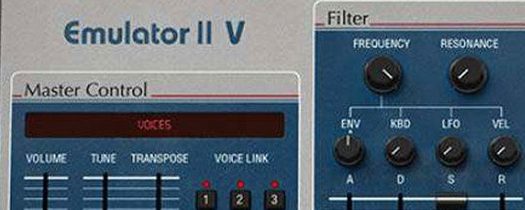
Arturia Emulator II V 1.6.2 (Mac)
Updated
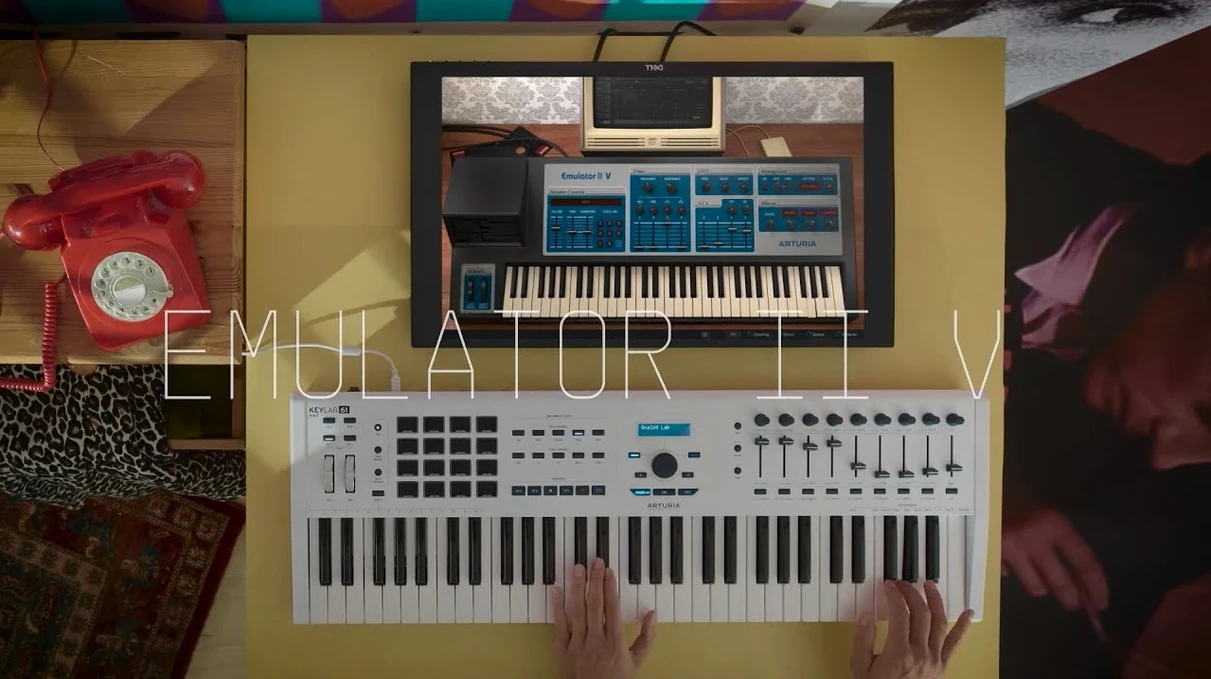
The catalogue note
Most samplers in a DAW end up doing the same few jobs: a stabbed chord here, a vocal chop there. The Emulator II V, Arturia's recreation of the E-Mu Systems 8-bit hardware sampler, earns its place by covering those jobs with a particular character. It sits on instrument tracks for melodic parts and on returns when you want its filters to colour a whole bus.
- Instrument track for a lead or bass patch, with the arpeggiator driving 32-voice polyphony.
- Multitimbral setup across eight voices, splitting the keyboard into zones for layered pads and brass stabs.
- Return bus for drum loops, running them through the per-layer VCF and LFO for that gritty, lo-fi movement.
- Sidechain or parallel track for texture layers, using the independent ADSR on each VCA to shape ambience.
- MIDI track controlling the graphic parameter editing, automating filter cutoff and envelope times live.
- Audio track for resampling the output, then feeding it back into the sampler for that classic hardware loop.
The interface keeps everything editable graphically, and the TAE-modelled circuits respond like the original. For a session that needs an 80s film-score vibe or a bit of dirt under a clean mix, this is a practical tool.
The grain is the point
The most common error is treating the Emulator II V as a modern sample player. People load a preset, expect pristine 24-bit playback, and wonder why it sounds grainy. That grain is the point. The 8-bit companding and 27.7 kHz sample rate are features, not bugs. If you want clean, use a Kontakt library. If you want that specific early-digital texture, lean into it — don't try to EQ the character out.
Another misstep is ignoring the per-layer VCF and ADSR. Each of the eight voices has its own filter and envelope section. Beginners often leave everything at default, then complain the patch sounds static. Spend a few minutes per layer: sweep the cutoff, adjust the LFO rate, tweak the VCA attack. The instrument rewards that kind of hands-on editing.
Some users also overlook the arpeggiator because it's not the first thing they see. They map a chord and hold a key, expecting the original hardware's limited polyphony. The 32-voice arpeggiator is one of the modern additions that makes the plugin more usable in a DAW environment. Set a pattern, route it through the filter, and you get movement that the original could not produce.
A final mistake: resampling the output without considering the signal chain. If you run the Emulator II V through a clean bus and bounce it, you lose the option to tweak the filter or envelope later. Record the MIDI first, automate the parameters, then resample once you are happy. That way you keep the flexibility the plugin offers.
Check system requirements before installing
Runs natively on Apple Silicon and Intel Macs
Yes. Version 1.6.2 (5305) supports both ARM and x86 64-bit architectures under macOS 11 and later. Arturia has kept the plugin compatible across the transition, so it runs natively on Apple Silicon without Rosetta overhead and on older Intel Macs without issues.
No original hardware required
No. The Emulator II V is a standalone software instrument. It does not require an E-Mu Emulator II sampler or any additional hardware. The TAE modelling recreates the circuits and behaviour in software, so you get the sound without the maintenance or the floppy disks.
Loads curated library, not user samples
The plugin ships with a curated library that includes Emulator and Synclavier samples alongside modern material. The interface is designed around editing those layers graphically. If you want to bring in your own audio, you would need to check the specific import options in the documentation included inside the package — the instrument's core workflow is built around its preset library rather than drag-and-drop sample loading.
Will it fit into my existing DAW workflow?
It runs as a plugin in any DAW that supports the standard formats. The graphic parameter editing means you can automate filter cutoff, envelope times, and LFO rates via MIDI, so it integrates with automation lanes and modulation sources in your host. The multitimbral setup across eight voices also works well with multi-output routing if your DAW supports it.
Ideal for 80s and 90s lo-fi textures
Music producers working in genres that draw on 80s and early 90s textures will find it immediately useful. Synthwave, retrowave, ambient, and film-score composers who want that lo-fi, gritty sound without resorting to bit-crushing plugins get a more authentic result here because the TAE modelling reproduces the actual circuit behaviour, not just a digital approximation.
Sound designers who layer samples benefit from the per-layer VCF, ADSR, and LFO. Each of the eight voices can be shaped independently, so you can build complex textures where one layer provides the attack transient and another provides the sustain body. The 250 original presets give a solid starting point, but the real value comes from modifying them.
Keyboard players who work in a DAW environment appreciate the 32-voice polyphony and the arpeggiator. The original hardware was monophonic in practice for many sounds; this version lets you play chords and arpeggios without voice stealing, which makes it more practical for live recording or MIDI sequencing.
Producers who already use other Arturia plugins — the V Collection or Analog Lab — will find the Emulator II V fits their existing workflow. The interface language is English, the activation is handled through Arturia's standard process, and the graphic parameter editing follows the same philosophy as their other recreations. If you have a library of Arturia arturia v collection pro mac torrent or arturia v collection 11 mac torrent sounds, this sampler adds a different flavour to that palette.
Routes eight voices to separate DAW tracks
In a DAW, the Emulator II V works as a standard instrument plugin. You can route its eight voices to separate tracks for individual processing, send the output to a bus with reverb or delay, and automate any of the graphic parameters via MIDI CC or host automation. The per-layer VCF and LFO respond to modulation, so you can use your DAW's envelope followers or LFOs to drive the filter in ways the original could not.
On macOS, the plugin benefits from the operating system's audio handling. Core Audio provides low-latency monitoring, and the plugin's 27.7 kHz sample rate and 8-bit companding do not place heavy demands on the system — it runs comfortably alongside other virtual instruments and effects. If you are using Audio Units, the format is supported natively.
For users who also run Arturia's other software, the Emulator II V can be layered with their synthesizer plugins for hybrid patches. A pad from the Emulator II V combined with a bass from a Minimoog recreation gives a contrasting texture that blends the digital grit with analogue warmth. The library's inclusion of Synclavier samples also means you can build cross-platform soundscapes without leaving the Arturia ecosystem.
The Arturia Emulator II V recreates classic 80s hardware sounds with a curated preset library for producers and sound designers. For producers who work with arturia mac torrent collections, this instrument adds a sampler that complements the synthesizer recreations.
Before it goes on the Mac
- macOS 11 or later
- Apple Silicon or Intel (x86 64-bit)
Installing it on the Mac
- Download the package and open it.
- Run the installer and follow the on-screen prompts.
- Installation and activation instructions are included inside the package.
Notes from the control room
Sign in or open a catalogue account to leave a note.
No notes from the room yet. If you have used this build for a week, a short note helps the next person.
Also filed under VST Plugins
The whole VST Plugins rack Arturia Mellotron V1.9.3 VST Plugins 2.1 GB
 Arturia Dist TUBE-CULTURE1.2.0 VST Plugins 370 MB
 Arturia CMI V1.13.2 VST Plugins 638 MB
 Arturia Modular V3.13.3 VST Plugins 707 MB
 Arturia Buchla Easel V1.13.2 VST Plugins 406 MB
 Arturia Rotary CLS-2221.2.0 VST Plugins 359 MB
 Arturia Analog Lab V5.12.6 VST Plugins 2 GB Updated
 Baby Audio IHNY-21.5.0 VST Plugins 28 MB