Home › Utilities › Raycast Pro
Raycast Pro 2.5.1 (Mac)
Updated
The catalogue note
You need to grab a quote from a webpage, jot down a thought, and send it to a colleague — all without losing your flow. Raycast can handle that in a handful of keystrokes.
One task from start to finish
- Open Raycast with your chosen shortcut. Type the name of a quick link you set earlier — say, ‘quotes’ — and it opens a reference site in your default browser.
- Still in Raycast, summon a floating note (Cmd+Shift+N). Paste the quote there, add your own note below it.
- Select the text in the floating note, copy it to the clipboard, then use Raycast’s iMessage integration to send it without leaving the keyboard.
Why this matters for a working day
That sequence — web search, personal note, share — would normally pull you between a browser, a notes app and Messages. Raycast keeps you inside the launcher for most of it. The floating notes live on top of other windows, so you never lose context. And because quick links let you specify which browser opens them, you stay in control of where the content lands. No crack is needed; the free tier already does this.
Requires macOS 12 or later on ARM and Intel Macs
Raycast 2.4.1.0 requires macOS 12 or later and runs on both ARM (Apple Silicon) and x86 64-bit Intel Macs. The installer is a standard disk image — mount it, drag the app to Applications, then launch from Launchpad. Activation is not required, so there is no account setup or licence check. The interface is in English only.
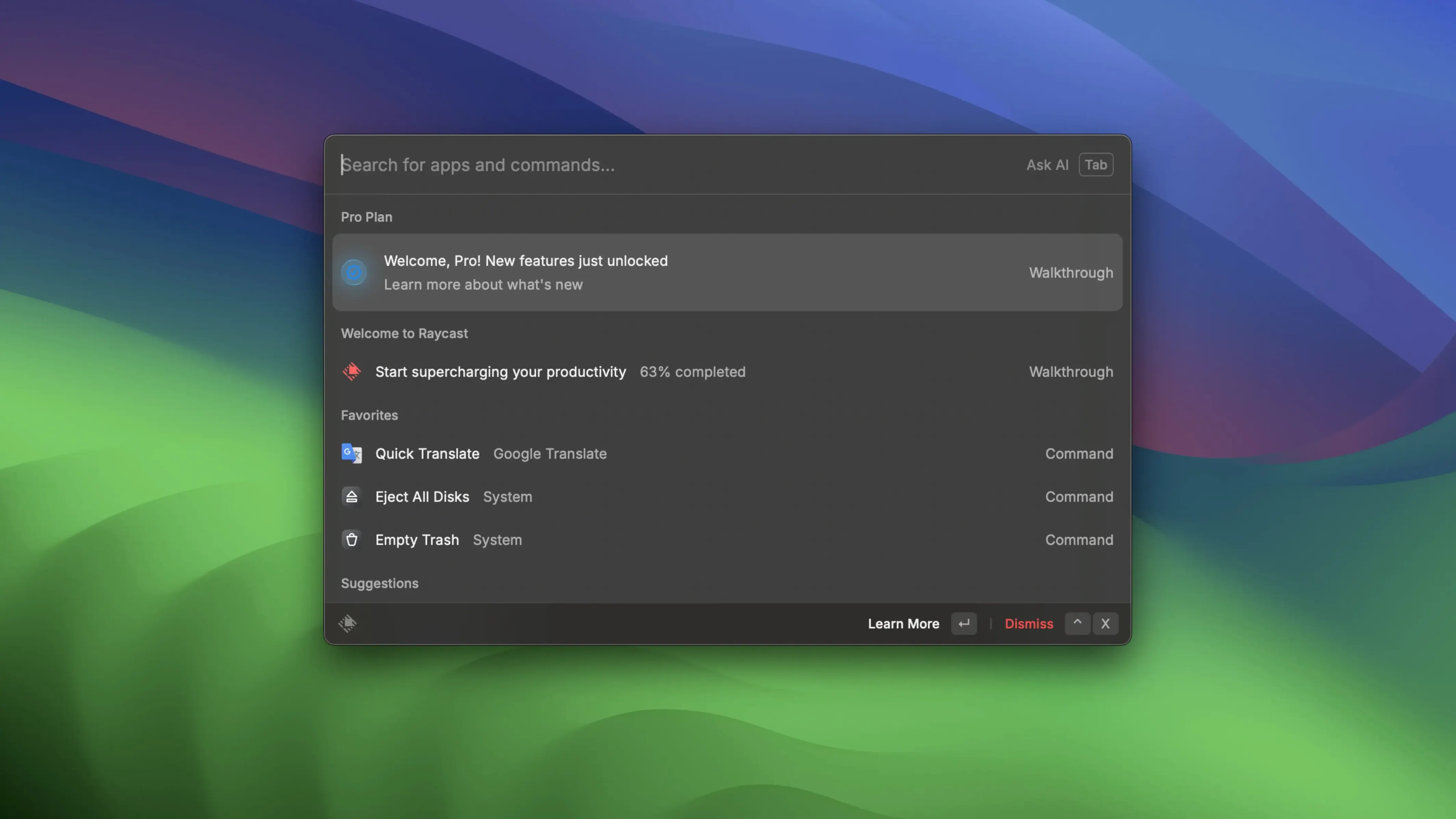
The app itself is a launcher and command palette. It does not need an internet connection to function, and online integrations — such as Google Drive, Google Docs or Zoom — are inactive in this build. What remains is the core set of tools: the launcher, the quick links, the floating notes, local file search and custom script support. Everything works locally and at the speed of your Mac’s search index and file system.
Because the app is an extension host, each community script or third-party connection runs as a separate process. The changelog for version 2.6, which is a later build, notes that the host process uses about 50% less memory and each extension uses about 30% less at startup compared to earlier versions, and that a memory leak that grew over time has been fixed. That suggests that the 2.4.1.0 build may show a different memory profile, especially if you keep Raycast open for long sessions or load several extensions. No measurements here — just something to keep in mind if you run many scripts.
Opens a floating notes window to jot down phone numbers
Morning. You sit down, hit Option+Space and the launcher appears. You type “notes” and the floating notes window opens. You jot down a few phone numbers from yesterday’s meeting. Later, you need to look up a client’s address — you type “address” into the launcher, but it’s not a quick link yet. You open a browser manually, copy the address, then use Raycast’s quick link feature to save the page as a link for next time. From now on, typing “client address” opens the page in your preferred browser.
Mid-morning, someone sends you a file in iMessage. You copy the filename, summon a floating note, paste the name and add a reminder to check it. You then select the text, copy it and use Raycast to send it back to yourself via iMessage as a cross-reference. No mouse touches the dock. The entire workflow stays in the launcher and the floating note layer.
Later, you need to find a local PDF. You type “.pdf” into the launcher and Raycast shows recent files from your index. You pick the one you need and open it directly. That’s the session: a handful of keystrokes per action, no window switching beyond the launcher itself.
Reassigning the default Option+Space shortcut to avoid clashes
You can set a custom shortcut for opening Raycast. The default is Option+Space, but if that clashes with another app’s shortcut — as it does on some systems — you can reassign it in the app’s preferences.
Quick links are worth setting up early. Decide which web pages you open daily: internal dashboards, reference sites, documentation. Add them as quick links so you can jump to them from the launcher. You can also set a default browser for each link.
Floating notes can be pinned so they stay on screen. That is useful for a to-do list or a scratchpad you need visible while working in another app. If you prefer minimal clutter, unpin them — they disappear when you click away.
Uses its own extension model instead of Albert's Python plugins
Albert is a free, open-source launcher for Linux and macOS. It has file search, calculator, custom extensions and a plugin system. Where Albert relies on Python plugins and a more traditional plugin folder structure, Raycast uses its own extension model and a dedicated store for community scripts. Raycast’s floating notes and iMessage integration are features Albert does not have natively. Albert is lighter on resources by design, but Raycast offers a broader set of built-in tools out of the box.
Hyperkey (formerly Tiles) is a macOS launcher and app-switcher that focuses on keyboard-driven window management and app launch. It does not include floating notes, quick links or script commands. Hyperkey is leaner, but Raycast gives you more ways to interact with data — copy, share, link — without leaving the launcher. For someone who needs a pure launcher, Hyperkey is a clean alternative. For someone who wants to write a quick note, send it, and search a file all in the same tool, Raycast is the more capable choice.
Alfred (the free tier) offers similar basics: file search, web quick searches, clipboard history and snippets. Raycast’s equivalent tools are available in the free build, assuming you are using the version without online functions. For users who do not need Alfred’s paid workflow features or its extensive PowerPack, Raycast is a strong alternative. If you already rely on Alfred’s snippet system and a large library of workflows, the switch cost is higher. For a new user, Raycast’s all-in-one approach is simpler to set up.
Before it goes on the Mac
- macOS 12 or later
- Intel or Apple Silicon
- English interface
- Activation not required; online functions do not work
Questions from the room
Can Raycast connect to third-party apps?
Yes, Raycast is an extensible launcher and can connect with third-party apps, including iMessage and Apple Notes.
Are floating notes shareable?
Yes, notes can be copied to the clipboard, sent in iMessage, or shared to Apple Notes directly from the floating note window.
Installing it on the Mac
- Mount the downloaded disk image.
- Drag the app to the Applications folder alias.
- After copying finishes, launch the app from Launchpad.
Notes from the control room
Sign in or open a catalogue account to leave a note.
No notes from the room yet. If you have used this build for a week, a short note helps the next person.