
Home › Logic Pro Plugins › Spire
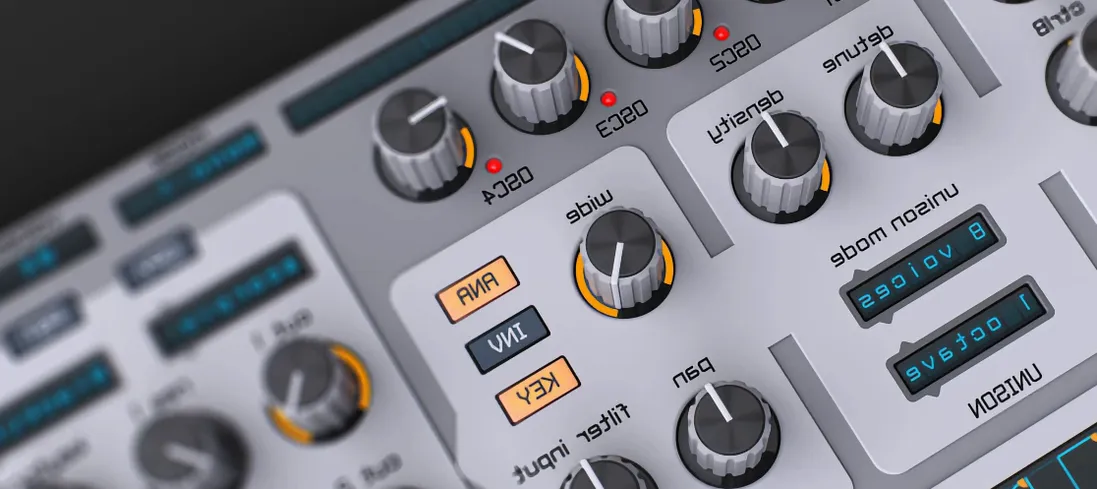
Spire 1.5.19 (Mac)
Updated
The catalogue note
Spire 1.5.19 runs on macOS 10.13 or later and supports both Intel and Apple Silicon Macs natively. No Rosetta translation needed on an M-series machine.
Plugin formats and host support for Spire
Plugin formats — Audio Units, VST 2, VST 3 and AAX. Covers Logic Pro, Ableton Live, Cubase, Pro Tools and most other modern DAWs.
Host support — works in any 64-bit host that loads AU or VST. No 32-bit version.
CPU and latency — moderate CPU footprint for a four-oscillator synth; well-behaved at standard buffer sizes.
Sound and architecture
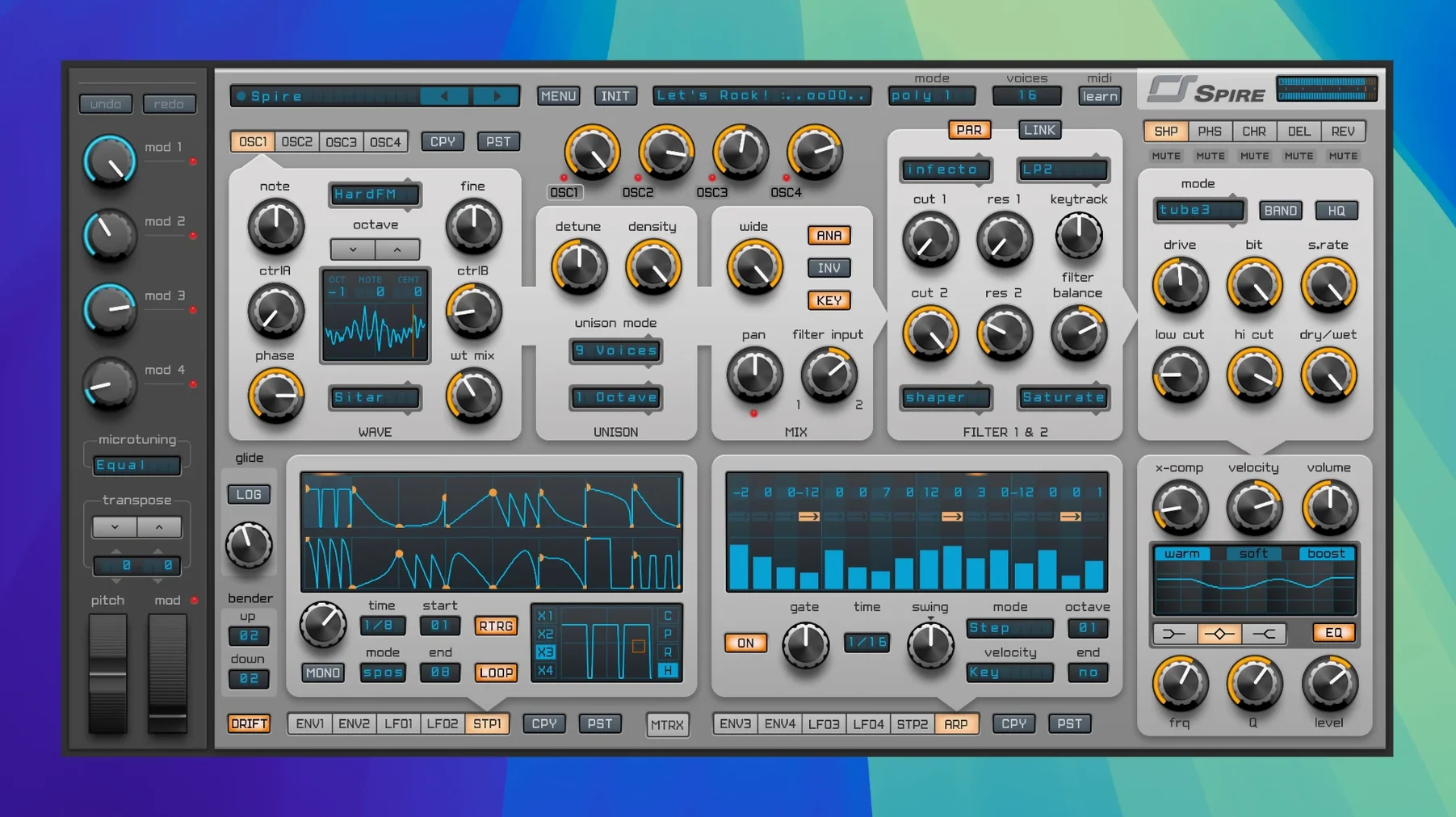
Oscillators — 4 per voice, with standard analogue waveforms, FM, sync and wavetable playback.
Filter — multimode with 12 and 24 dB/oct slopes; low-pass, high-pass, band-pass and notch.
Modulation — 2 LFOs, 2 ADSR envelopes, plus the step sequencer and arpeggiator can route to multiple targets.
Effects — delay, reverb, distortion, phaser and EQ built in, all per-patch.
Presets — factory library of over 1500 sounds, plus user preset slots.
Runs natively on Apple Silicon without Rosetta
Does it work on Apple Silicon without extra steps?
Yes. Spire ships native binaries for both Intel x86 and Apple ARM chips. You do not need Rosetta. On an M-series Mac it runs as a native application, same as on an older Intel machine.
Can I run it alongside other synths in the same session?
Yes, provided your DAW is 64-bit. Spire is a standard AU/VST/AAX plugin and behaves like any other virtual instrument. It does not require its own audio driver or a dedicated core. It works in multitimbral setups if your host supports multiple instances on separate MIDI channels, though each instance loads its own patch.
Do I need an iLok or a hardware dongle?
No. The installer includes instructions for both installation and activation. There is no physical dongle and no always-on internet requirement after the initial unlock.
Will it replace my existing hardware or software synths?
That depends on your sound. Spire covers a lot of ground with its four oscillators and wavetable engine, but it has its own character — clean, modern, precise. If you work in dubstep, trance, house or techno, it will fit naturally. If you need analogue emulation or vintage grit, you may still reach for something else.
The current store version is 1.5.22. The version described here is 1.5.19.
Designed for electronic music producers with arpeggiator and sequencer
Electronic music producers — this is the primary audience. The arpeggiator, step sequencer and modulation matrix are built for sequenced, pattern-based music. House, techno, trance, dubstep, ambient and IDM all benefit from the flexible routing and the 1500+ preset library.
Sound designers — four oscillators with wavetable support and FM give you enough raw material to build evolving textures. The filter slopes and the effects chain (delay, reverb, distortion, phaser, EQ) let you further shape those sounds without leaving the plugin window.
Mac users who want a native, no-fuss synth — because Spire ships as a native Apple Silicon build with no Rosetta layer, it integrates neatly into a modern Mac workflow. No performance penalty, no extra compatibility checks.
Live performers — the arpeggiator and step sequencer can generate patterns in real time, and the modulation matrix lets you assign multiple controllers to filter cut-off, LFO speed or oscillator pitch. If you use a MIDI controller with knobs or faders, Spire responds immediately.
Start with over 1500 factory presets in any DAW
I open a new session in my DAW, create a MIDI track and load Spire as the instrument. The interface appears. I start with the factory presets — there are over 1500, so I browse by category until I find a pad that is close. It is a layered wavetable patch with a slow LFO on the filter.
I play a few chords. The sound is clean but needs movement. I route a second LFO to the oscillator pitch, set it to a slow sine wave, and adjust the depth. The pad starts breathing gently. I activate the arpeggiator, set it to sixteenth notes and the pattern to up-down. The chords turn into a rhythmic sequence.
I record a four-bar MIDI loop. I want a bassline next, so I duplicate the track, choose a new instance of Spire and pick a monophonic bass preset. I tweak the filter envelope — short decay, no sustain — and assign after-touch to the filter cut-off. I play the bass notes manually, one per quarter note. The filter opens when I press harder on the key.
Back to the main pad. I add the built-in reverb, set the decay to medium and the mix to about a third. The delay is next: a dotted eighth note pattern, feedback low. The pad now sits behind the bassline without cluttering the low end.
I export the MIDI to audio, bounce both tracks into stems and move on to arrangement. Spire stays open on the pad track so I can tweak the LFO rate during the build-up section. The whole process takes about twenty minutes. No menus, no extra windows. The synth stays on one screen.
Real-world scenario: A techno producer finishing a live set
Karolina produces techno for a label in Berlin. She is putting together a live set for an upcoming show. She needs a synth that can handle both lead lines and bass, and that she can tweak quickly during a performance without looking at the screen too much.
She loads Spire on a dedicated laptop running macOS. She builds three patches: a resonant bass with the filter set to low-pass 24 dB and the envelope fast, a metallic lead using FM and the step sequencer for rhythm, and a noise-based riser with the LFO sweeping the filter cut-off. She assigns each patch to a different MIDI channel. Her controller sends program change messages to switch between them during the set.
During the rehearsal she notices the lead is too bright. She reaches over, lowers the filter cut-off by a few semitone steps and increases the filter resonance. The change is instant. She decides to add a phaser to the riser. She enables the phaser effect, sets the rate to sync with the master BPM and leaves the mix at unity. The riser now has a subtle sweep before the drop.
The whole patch design and sound check takes under an hour. She exports the patches as user presets so they load automatically next time. No extra cables, no external hardware to fail on stage. Spire becomes one of the three synths she relies on during the set.
Changes in this build
- Build 5343 for version 1.5.19.
Before it goes on the Mac
- macOS 10.13 or later
- Intel or Apple Silicon processor
- 64-bit host DAW
Questions from the room
Does Spire work on Apple Silicon Macs?
Yes. Spire 1.5.19 runs natively on Apple Silicon and Intel Macs, no Rosetta required. Compatible with macOS 10.13 and later.
Installing it on the Mac
- Run the included installer.
- Follow the activation instructions provided with the download.
Notes from the control room
Sign in or open a catalogue account to leave a note.
No notes from the room yet. If you have used this build for a week, a short note helps the next person.
Also filed under Logic Pro Plugins
The whole Logic Pro Plugins rack Soundtheory Gullfoss1.11.7 Logic Pro Plugins 176 MB
 Sonible pure:level1.0.2 Logic Pro Plugins 59 MB
 Slate Digital Submerge1.0.5 Logic Pro Plugins 38 MB
 Slate Digital Storch Filter1.0.6 Logic Pro Plugins 69 MB
 Slate Digital Murda Melodies1.1.1 Logic Pro Plugins 179 MB
 Slate Digital Fresh Air1.0.9 Logic Pro Plugins 40 MB
 Supertone Air1.0.1 Logic Pro Plugins 408 MB
 Synapse Audio The Legend HZ v2.0.2.R12.1 Logic Pro Plugins 472 MB