
Home › Logic Pro Plugins › Neural DSP Archetype Petrucci

Neural DSP Archetype Petrucci 1.0.0 (Mac)
Updated
The catalogue note
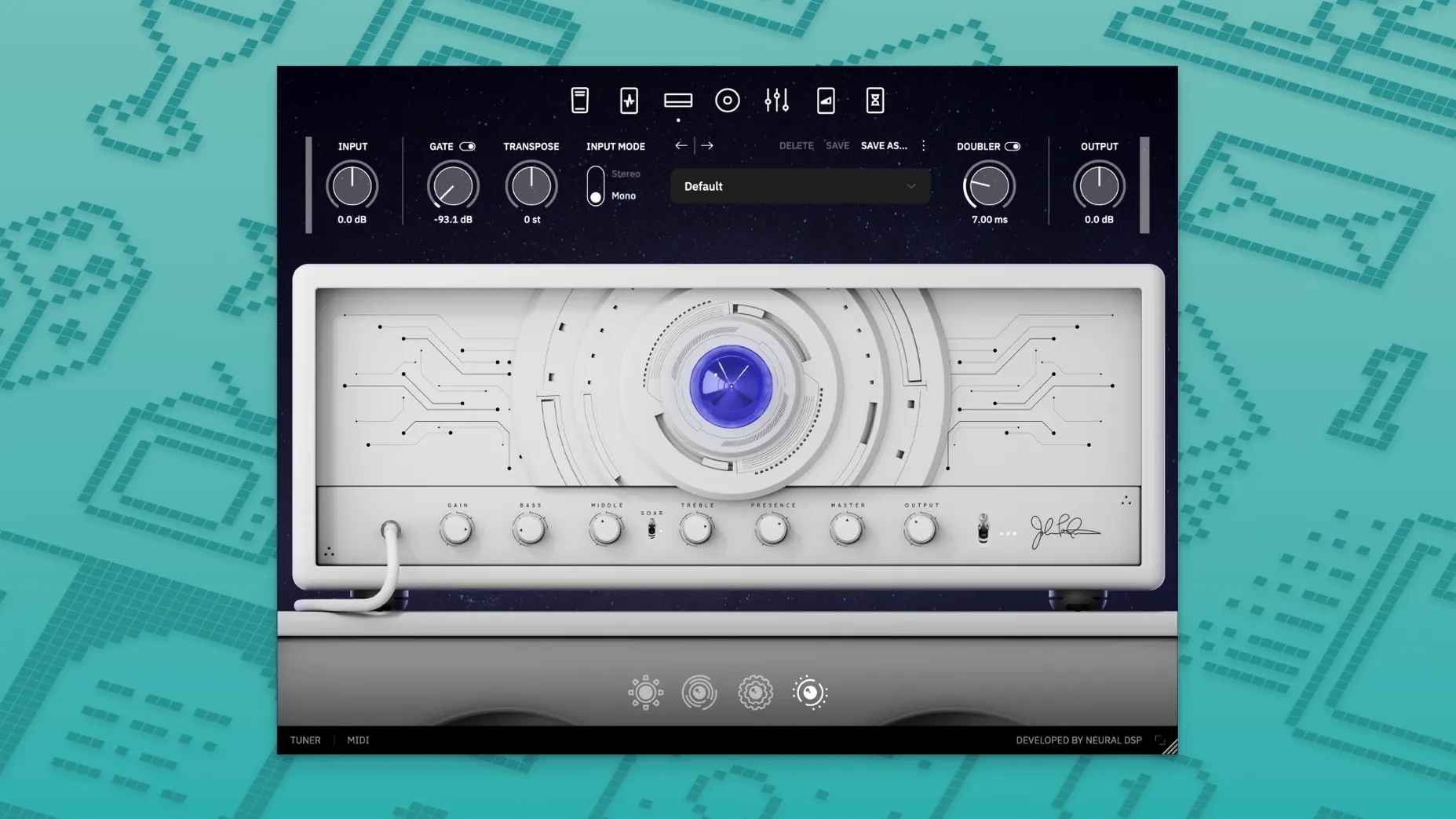
Set the plugin’s input gate and noise suppression to taste before you hit record — Petrucci’s front end is clean enough that you can dial in a tight chug without fighting the room. Insert Archetype Petrucci on a mono audio track or instrument track. The first step is to pick an amp channel: clean, crunch, lead, or the signature JP rhythm voicing. Each channel responds differently to your pick attack, so spend a minute finding the one that matches the part.
- Route the guitar DI into the plugin on a mono track. Set the input level so the meter hovers around -12 dBFS.
- Select an amp channel and adjust the three-band EQ on the amp head. Keep the bass tight, the mids present, the treble clear.
- Add the built-in overdrive or boost pedal in front of the amp if you need more saturation or a mid push.
- Use the delay and reverb sections on an aux send rather than inline if you want to blend the wet signal separately — the plugin’s internal routing handles both series and parallel.
- Print the DI and the processed track to two separate channels so you can re-amp later without re-recording.
Archetype Petrucci runs in 64-bit VST2, VST3, AU, AAX, and standalone on macOS 10.15 and later. It natively supports Apple Silicon and Intel. The same presets transfer to the Quad Cortex hardware. The interface is English only.
Room mic mix knob is easy to miss
The plugin's cab section is worth a second look. Beneath the main mic position controls, there's a separate mix knob for the room mic — not every Archetype plugin makes that independent adjustment so obvious. If you want a less direct sound without switching to a different IR, pull the room mic up and blend it underneath the close mic. The result stays coherent because both signals come from the same cabinet model.
The transpose function lives on the main toolbar, not buried in a sub-menu. Shift the pitch by semitones for drop-tuning without leaving the session, or use it to play a part an octave lower without re-recording. It tracks fast enough for rhythm work, though you will notice the latency if you monitor through it live — better to print and play back.
Each amp channel stores its own noise gate threshold separately. If you switch from the clean channel to the lead channel and the noise floor jumps, adjust the gate on that channel rather than the global input gate. The plugin remembers the per-channel setting when you save the preset.
The delay and reverb sections each have an independent mix knob that works in series or parallel, but the series/parallel switch sits on the reverb block. Most users find the parallel setting first and never try series — series feeds the delay into the reverb, which gives a more diffuse wash for ambient leads. Try it once to hear the difference.
Over-processing the clean channel is the most common error
The most common error is over-processing the clean channel. Petrucci's clean amp has a lot of headroom and a glassy top end. New users often pile on compression and EQ to make it sound "produced," when the raw signal through a good cabinet IR already has the clarity that sits in a mix. A slight high-pass at 80 Hz and a touch of room mic is usually enough.
Another mistake is ignoring the input level. The plugin does not clip internally until you hit the red, but running the input too hot (above -6 dBFS) saturates the preamp stage earlier than intended. The lead channel will compress more than you expect, and the clean channel loses its transient snap. Keep the meter around -12 dBFS as a starting point, then adjust by ear.
Beginners also tend to use the built-in overdrive pedal as a standalone boost without adjusting its internal tone stack. The pedal's EQ interacts with the amp's input stage — if you set the pedal's tone knob to noon and the amp's treble to 3 o'clock, the result can be harsh. Drop the pedal's tone to 10 o'clock and let the amp's EQ do the shaping instead.
Finally, many users forget to check the stereo width on the delay and reverb returns.
Full 64-bit support for macOS and Windows at launch
The initial release of Archetype Petrucci at version 1.0.0 brought the plugin to both macOS and Windows with full 64-bit support across VST2, VST3, AU, AAX, and standalone formats. For existing Quad Cortex users, the most noticeable change is that presets created on the hardware now load directly in the plugin and vice versa — the same DSP modelling runs on both platforms. This means you can dial in a tone on the plugin at your desk, export the preset, and use it on stage through the Quad Cortex without tweaking.
Native Apple Silicon support arrived with this version as well, so the plugin runs in native mode on M-series Macs without Rosetta translation. The standalone application launches quickly and recognises your audio interface directly, which is useful for quick practice sessions without opening a DAW.
Version 1.0.0 also introduced the full set of amp channels (clean, crunch, lead, JP rhythm) and the effects chain — overdrive, delay, reverb, noise gate, and transpose — all at once. There are no feature gaps compared to the hardware unit, so you are not missing any effects or routing options when working in the box.
Workflow: recording a rhythm track from scratch
Here is a straightforward workflow for recording a palm-muted metal rhythm part, from setting up the track to committing the take.
- Create a mono audio track in your DAW. Insert Archetype Petrucci as the first plugin. Set the input to your DI signal and the output to the main bus.
- Select the JP rhythm amp channel. This voicing is voiced for tight low-end and aggressive mids — it cuts through a dense mix without needing a lot of post-EQ.
- Set the amp's three-band EQ: bass at 2 o'clock, mids at 1 o'clock, treble at 11 o'clock. Adjust the gain knob until the distortion feels responsive but not fizzy — around 3 o'clock is a good starting point.
- Add the overdrive pedal in front of the amp. Set the drive to 8 o'clock, tone to 10 o'clock, level to 3 o'clock. This tightens the low end and adds a slight mid boost without turning the sound into fuzz.
- Adjust the noise gate threshold on the JP rhythm channel so it closes cleanly between palm-muted chugs but does not chop off the sustain of a held note.
- Record a few bars of DI. Listen back and tweak the amp's presence control if the attack is too dull or too piercing. The presence knob affects the upper harmonics without changing the overall treble balance.
- Once the tone is right, record the final take. Print the processed track to a new audio file so you can bypass the plugin and save CPU. Keep the DI track muted but in the session for potential re-amping later.
Archetype Petrucci vs. Gojira: two different tonal targets
Archetype Petrucci sits alongside a few other premium guitar amp sims that run natively on macOS. The most direct comparison is with Neural DSP's own Archetype: Gojira. Both plugins share the same engine and routing flexibility, but Gojira leans toward modern extreme metal — its amp voicings are more aggressive and its effects include a pitch shifter and a harmoniser that Petrucci lacks. Petrucci, by contrast, has a broader clean-to-crunch range and the JP rhythm channel that works for progressive and rock styles. If you write varied material that needs clean arpeggios and heavy riffs from one plugin, Petrucci is the more versatile choice.
Amplitube 5 by IK Multimedia offers a different approach. It models dozens of amps and cabinets from different brands, so you can mix and match any head with any cab. The trade-off is that each model is a snapshot of one specific amp, not a voicing designed by an artist for consistency across channels. Petrucci gives you four carefully matched channels that work together without needing to audition 50 different cabinets. Amplitube wins for breadth; Petrucci wins for speed and cohesion.
Line 6 Helix Native is another option for macOS users. Its modelling is excellent and its routing is the most flexible of the three — you can place effects anywhere, split paths, and run dual amps in parallel. However, Helix Native's interface is denser and its default presets are more generic. Petrucci gets you to a usable tone faster because the amp channels and effects are pre-optimised for a specific playing style. For someone who wants to dial in a lead sound in under a minute, Petrucci is the more direct tool. For deep experimental routing, Helix Native remains the leader.
Team Flare Neural DSP delivers the Archetype Petrucci plugin, a guitar amp sim suited for progressive metal musicians.
Changes in this build
Before it goes on the Mac
- macOS 10.15 or later
- 64-bit host (VST2, VST3, AU, AAX, or standalone)
- Native Apple Silicon and Intel support
Questions from the room
Can I use Archetype Petrucci as a standalone app without a DAW?
Yes. The plugin comes in standalone format, so you can play through it without opening a DAW.
Does Archetype Petrucci work with the Quad Cortex?
Yes. The plugin is compatible with Quad Cortex and Quad Cortex Mini, and presets transfer between them.
Installing it on the Mac
- Open the downloaded disk image.
- Run the standard installation procedure.
Notes from the control room
Sign in or open a catalogue account to leave a note.
No notes from the room yet. If you have used this build for a week, a short note helps the next person.
Also filed under Logic Pro Plugins
The whole Logic Pro Plugins rack Neural DSP Archetype Rabea X1.0.1 Logic Pro Plugins 742 MB
 Neural DSP Parallax X1.0.0 Logic Pro Plugins 179 MB
 Neural DSP Soldano SLO-100 X1.0.0 Logic Pro Plugins 340 MB
 Native Instruments Massive X2.0.0 Logic Pro Plugins 2.3 GB Updated
 noteGRABBER2.0.0 Logic Pro Plugins 35 MB
 Omnisphere3.0.2c Logic Pro Plugins 205 MB
 Output Portal1.2.1 Logic Pro Plugins 319 MB
 Minuit Solstice1.2.0 Logic Pro Plugins 117 MB