Cubase 16.0.5 (Mac)
Updated
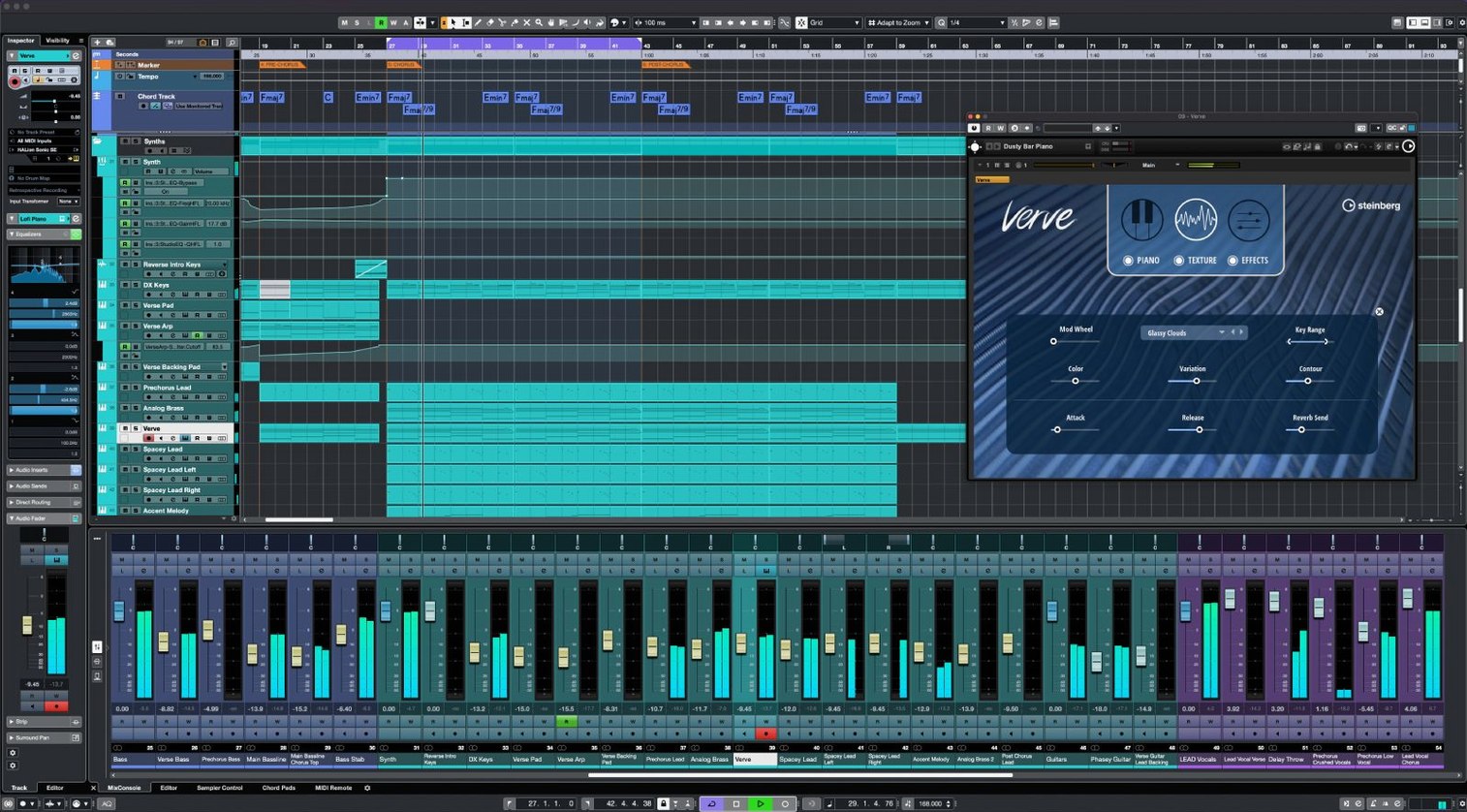
The catalogue note
A producer sits down with a fresh Cubase 15 project on a Mac Studio M2 Max. The cursor blinks on an empty arrangement. No loops, no MIDI clips yet. Where to start? Here is a short workflow for a newcomer, not a deep dive—just the steps that get something useful happening quickly.
Set up a project and add a track
Create a new empty project. Add an audio track from the Project menu. Arm it for recording and check your input. Cubase 15 supports up to 256 physical inputs and outputs, so even a large interface shows up without fuss.
Record or import audio, then align it
Record a vocal line or drag in a stereo file. If the timing is off, use AudioWarp to snap the audio to the project grid and tempo. It works in real time—no destructive edits needed.
Pitch-correct with VariAudio
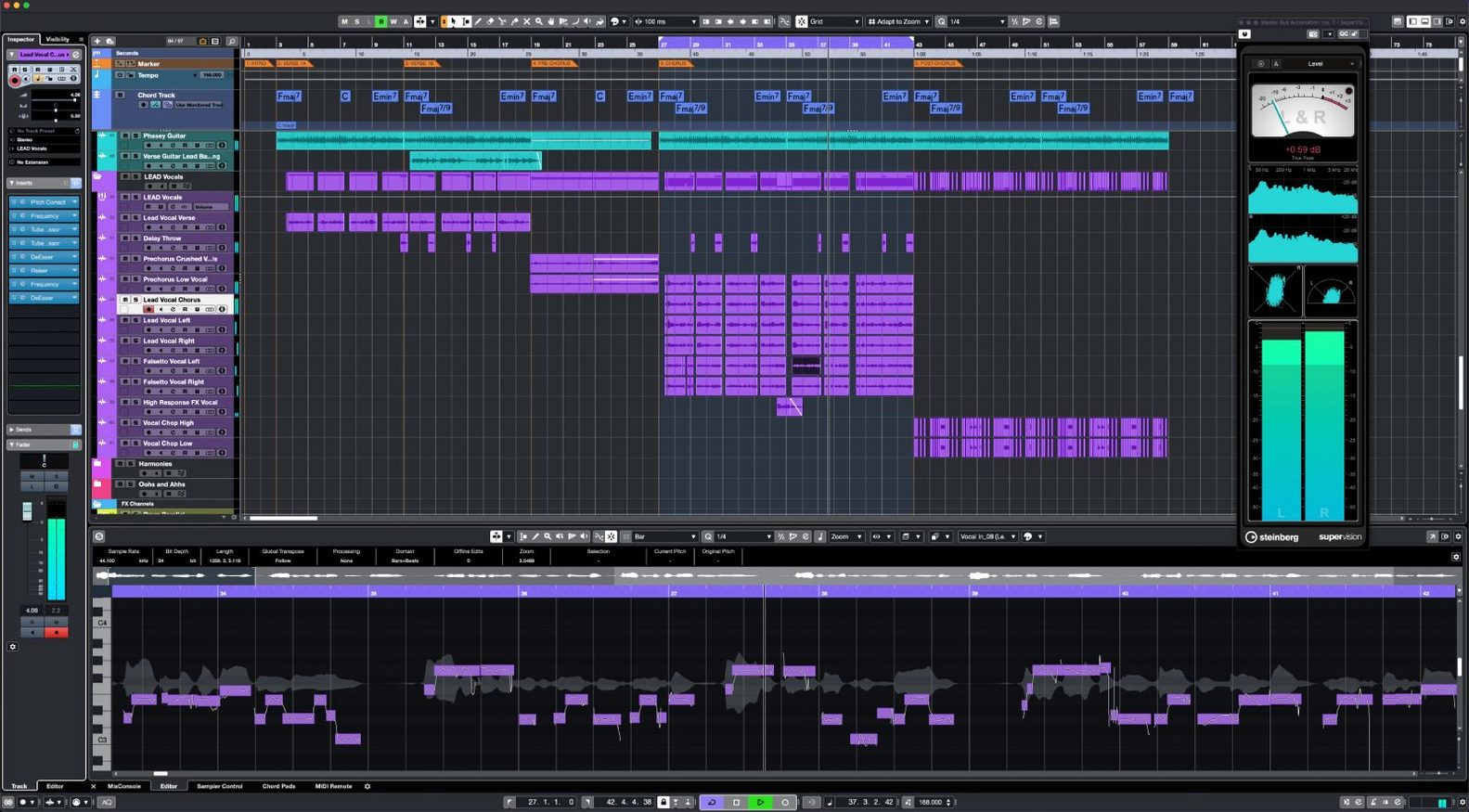
Select the audio event and open VariAudio from the lower zone. The waveform gets an overlay of pitch segments. Drag a wayward note back to pitch. It is quick, and it stays inside the same editor.
Drag audio clips to a VST instrument from the chord track
Right-click the audio clip and choose Audio to MIDI Chords. Cubase analyses the harmony and writes a chord track. You can then drag that MIDI to a VST instrument—there are 64 slots available—and experiment with different sounds.
From there, you have a basic arrangement: a loop, a vocal corrected for pitch and timing, and a MIDI part derived from your audio. The rest is arrangement and mixing. Cubase 15 gives you the tools; these steps give you a starting point.
Cubase runs on macOS 13 with a single installer for Intel and Apple Silicon
The most common concern is whether Cubase 15 will run on a particular Mac. The minimum is macOS 13, and the installer works on both Intel and Apple Silicon machines. There is no separate build for each architecture—one package handles both, and the license you apply determines which edition opens (Artist, Pro, Elements). The download itself is under 1.3 GB, so it does not take long to pull down even on a standard broadband connection.
Another frequent question is about the Steinberg Download Assistant. You need it to get the installer; it is not optional. The assistant handles the download and keeps track of updates. Once installed, Cubase 15 checks for licenses through the eLicenser or Soft-eLicenser system, so have that ready before you launch for the first time.
People also ask whether older Cubase projects open cleanly. Generally yes—Cubase 15 opens projects from Cubase 12 and earlier, though some plug-ins may need updating if they were 32-bit or relied on older VST versions. The project file format has not changed radically, so migration is straightforward for most users.
A film composer uses the tempo track to match scene changes for a documentary
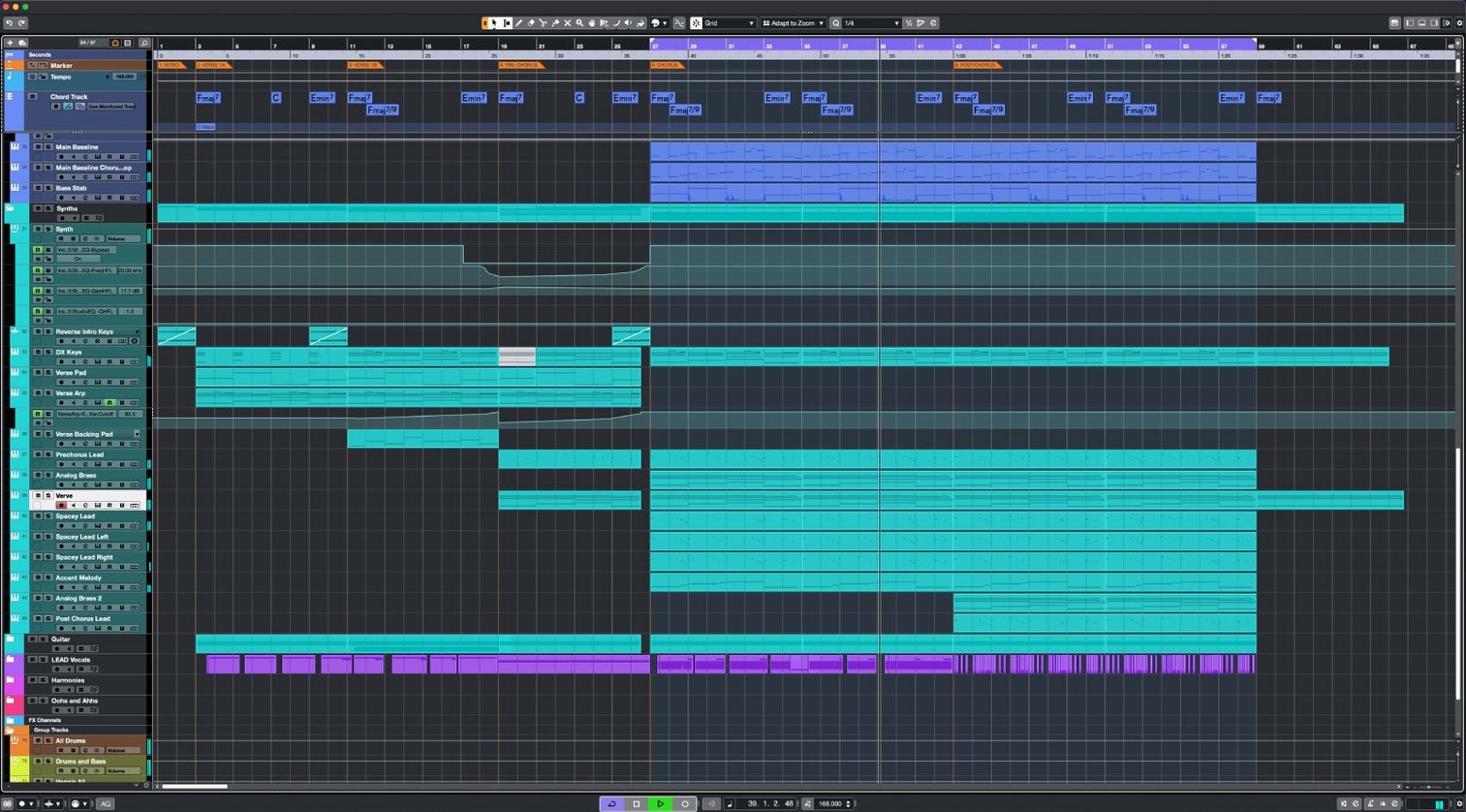
A film composer working on a short documentary imports a stereo guide track from the editor—roughly twelve minutes of dialogue and atmos. She sets up a tempo track to match the scene changes, then records a piano part using a VST instrument. The timing of one phrase drifts slightly against the picture. She selects the audio event, opens VariAudio, adjusts the pitch of a single note that sounded flat, then uses AudioWarp to nudge the whole phrase a few frames earlier. Later she uses Audio to MIDI Chords on a guitar loop she recorded years ago, turns the resulting MIDI into a string part, and drops a Raiser compressor on the master bus to bring the level up without the mix losing its open feel. The project stays at 48 kHz throughout, but Cubase 15 supports up to 192 kHz if the final delivery demands it.
For this kind of user, the unlimited audio and MIDI tracks matter less than the ability to move fast between pitch correction, tempo alignment, and chord detection without opening separate windows. The session stays in one place.
Map a few key commands from your old DAW in twenty minutes
Start by mapping a few key commands that match your old DAW habits. Cubase 15 has a deep keyboard shortcut system, and you can assign almost any function. Spend twenty minutes setting up shortcuts for common actions—record, stop, toggle metronome, open the mixer—before you start a real project. It saves a lot of menu hunting later.
Open the MIDI Remote setup early. If you have a controller, link it through MIDI Remote rather than relying on generic MIDI learn. The custom mappings survive project changes and can be saved as presets. This is especially useful if you switch between a keyboard and a pad controller.
Do not skip the FX Modulator. It is easy to overlook on a first run, but it can turn a static pad into something that moves. Route a synth track through an FX Modulator, set a slow LFO on a filter cutoff, and listen for a few bars. It takes seconds to set up and can change a mix quickly.
Keep an eye on the release notes for each update. Cubase 15.0.30, for example, added support for Novation Launch Control Series 3 and updated the MIDI Remote API. Those additions matter if you use that hardware or plan to build custom controller scripts. The notes are short and worth reading.
Large template setups with 16 GB of RAM get the real benefit
Anyone on a Mac with at least 16 GB of RAM will find Cubase 15 usable for most sessions. The real benefit appears for users who run large template setups—orchestral libraries, multiple instances of Kontakt, dozens of audio tracks—because the unlimited channel count and 256 group channels let you organise everything without hitting arbitrary ceilings. Composers working with sample libraries on a Mac Studio or a MacBook Pro with M-series chips get the advantage of the unified memory pool and the 64-bit sound engine, which handles high sample rates and dense projects without choking.
Producers who mix in surround or Dolby Atmos will find the Atmos tools built in rather than bolted on. If your Mac runs macOS 13 or later and you have a multichannel interface, Cubase 15 can handle the bed and object routing directly. That saves buying additional software just to deliver an Atmos mix.
On the lighter end, someone using a MacBook Air with 8 GB of RAM can still record a few tracks and apply VariAudio or Raiser without the system struggling. The application does not demand a top-spec machine for smaller projects. It scales down reasonably well, though heavy VI usage will push the memory limit quickly.
In short, the users who benefit most are those who need the channel count, the surround tools, or the integrated pitch and tempo correction—and who work on a Mac that can feed those features with enough RAM and a decent audio interface.
Changes in this build
Steinberg have pushed out Cubase Pro 16.0.5. The full list of changes sits on the Steinberg site under the release notes section.
Before it goes on the Mac
- macOS 13 or later
- Apple Silicon or Intel 64-bit Mac
Questions from the room
Does Cubase 15 support MIDI controller mapping?
Yes, MIDI Remote integration lets you link MIDI controllers with Cubase and create custom mappings. It also supports Novation Launch Control Series 3.
Can I correct vocal pitch in Cubase 15 without third-party plugins?
Yes, VariAudio is included for vocal correction. It works directly on audio events in the lower zone editor.
What does Audio to MIDI chords do?
It detects harmony in an audio clip and converts it to MIDI notes. You can then route that MIDI to any VST instrument slot.
Installing it on the Mac
- Use the included installation instructions.
- Follow the included activation instructions.
Notes from the control room
Sign in or open a catalogue account to leave a note.
No notes from the room yet. If you have used this build for a week, a short note helps the next person.