Glyphs 4.2 (Mac)
Updated
The catalogue note
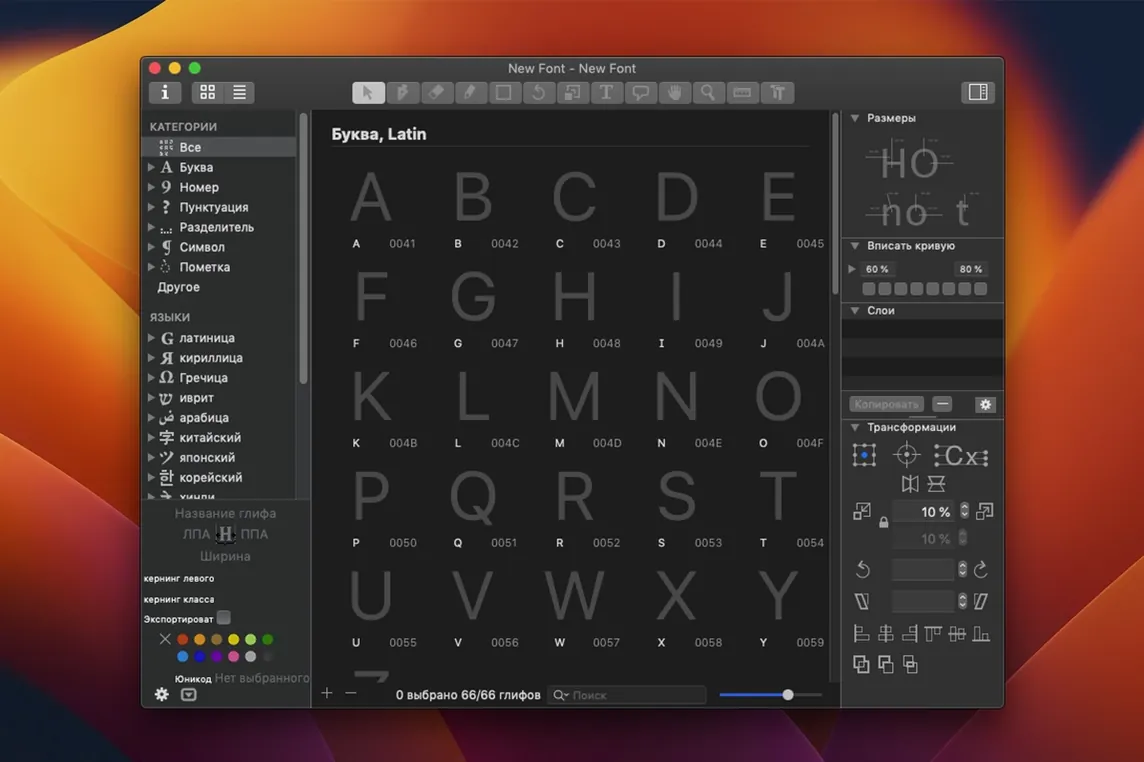
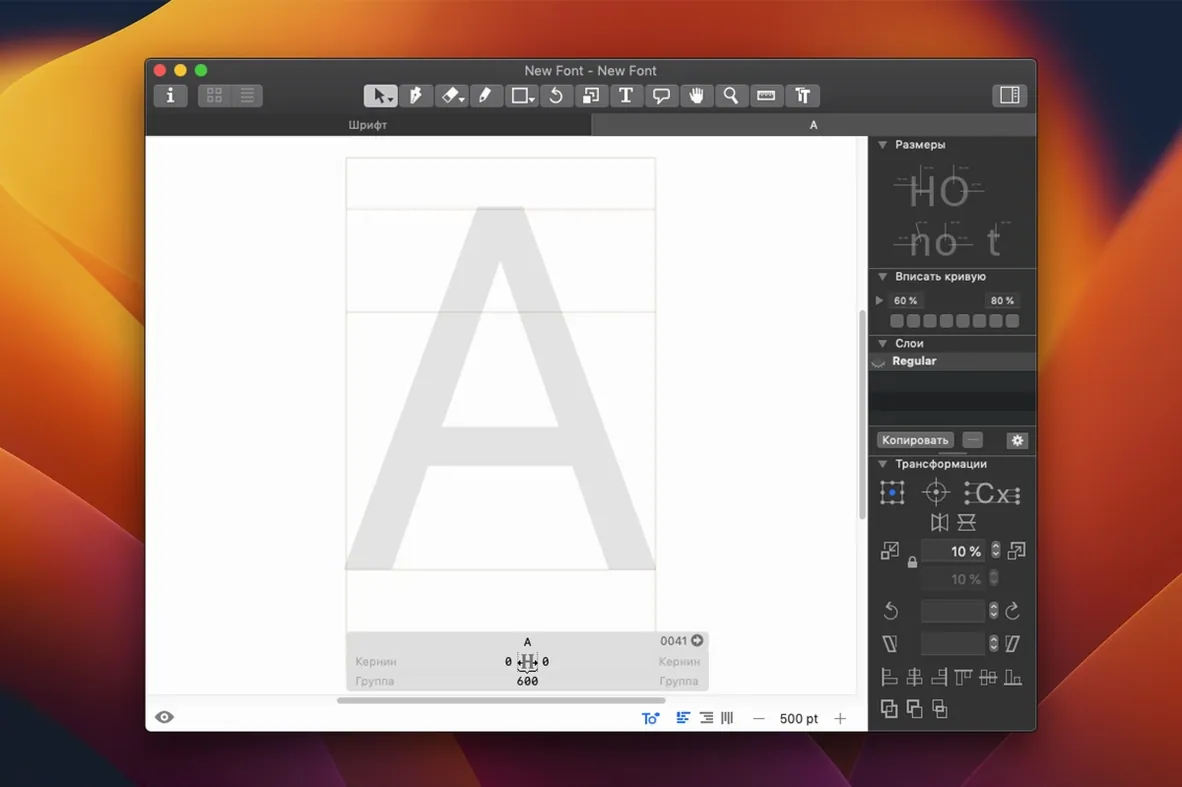
The contextual menu text editing in Glyphs lets you adjust glyph shapes or spacing without leaving your main workspace. It is the kind of detail that suggests the developer understands how type designers actually work — fast, iterative, often inside the same glyph for hours.
Runs on Apple Silicon and Intel, exports PNG, SVG, PDF and SFSymbols
- Does it run on Apple Silicon or Intel? Yes. Glyphs supports both ARM and 64-bit x86 Macs, provided you are on macOS 12 or later.
- What formats can it export? PNG, SVG, PDF, and SFSymbols are all available directly from the file menu.
- Is there a companion app for previewing fonts? Glyphs Viewer is a separate app that refreshes as you edit in Glyphs — useful for checking a full typeface without switching windows.
- How many interface languages does it include? Fourteen, among them English, Russian, German, Spanish, Italian, Traditional and Simplified Chinese, Korean, Portuguese, Turkish, French, Czech, and Japanese.
- Does it integrate with macOS tools? It hooks into the OS workflow and keeps only the interface elements needed for the task at hand, so the workspace stays uncluttered.
Drop SVG glyphs straight into web mockups or presentations
Glyphs sits well inside a typical type designer's toolchain. You can design a character, export an SVG glyph, and drop it straight into a web mockup or a presentation without intermediate conversions. The export to PDF matters when you need to send proofs to a client who does not have font software installed — the vector outlines remain sharp, and the file opens in Preview or any PDF reader without fuss.
For developers working on SF Symbols or custom icon fonts, the SFSymbols export is a direct bridge to Xcode projects. You design the symbol in Glyphs, export it, and import the resulting file into an asset catalogue. No round-tripping through a third converter.
The contextual menu editing is where the OS integration shows itself. Right-clicking a glyph brings up options that feel native because they follow the standard macOS menu conventions. If you are used to the system-wide text services or Quick Actions, Glyphs respects that muscle memory rather than replacing it with custom panels.
Scripts extend the app further. You can automate repetitive tasks — batch-adjusting side bearings, renaming glyphs, or generating test strings — by writing or installing AppleScript or Python scripts. The interface module for extending functionality means that if you need a tool the app does not ship with, someone has probably scripted it already, or you can build it yourself without digging into the core code.
Glyphs Viewer runs alongside the main app on a second monitor or in a window. It updates live as you edit, so you see the full typeface in context — a paragraph of text, a headline, a list of symbols — while you tweak a single curve. That separation keeps the editing workspace small and focused, and the preview space large and informative.
Build 4108 tightens existing behaviour without new panels
Build 4108, dated 12 September 2026, is the current release. The changes in this version are refinements rather than overhauls. If you have been working in Glyphs 4 for a while, the update tightens existing behaviour without introducing new panels or workflows you need to learn.
The release notes point to fixes in export reliability and interface behaviour. For daily work, that means fewer interruptions when you batch-export a family of fonts, and fewer oddities in the contextual menu or the script interface. If you have been hesitating to update because a previous minor version introduced a quirk, 4.1.1 addresses those.
There is no new export format, no redesigned inspector, no added language. The update is about stability. For a professional font editor, that is often more valuable than a new feature — you want the app to do its job without surprises when you are ten hours into a typeface.
Refining a single uppercase R and checking spacing against H and O
A type designer I know works on display faces for independent foundries. She spends most of her time in Glyphs adjusting the curves of a single uppercase R, then checking the spacing against the H and O, then exporting a test PDF to show the foundry owner.
Her workflow in version 4.1.1 goes like this: she opens the source file from iCloud Drive (the app handles cloud-stored files without corruption, provided the file is fully synced before she opens it). She edits the R's right sidebearing using the contextual menu text editing — right-click on the glyph, adjust the value, move on. She switches to Glyphs Viewer on a secondary display to see the R in a full sentence. The preview updates as she changes the sidebearing, so she can judge the colour of the typeface without exporting every time.
When she is satisfied, she exports a PDF proof and sends it via email. The export takes a few seconds, and the PDF retains the precise vector outlines. She also exports an SFSymbols file for a developer who is building a custom keyboard app, because the foundry occasionally sells icon sets alongside the typeface.
She does not use scripts heavily, but she has one that renames all glyphs to a new naming convention when the foundry changes its library structure. That script runs from the Scripts menu, and version 4.1.1 has not broken it — which is the kind of stability she values more than any new tool.
That covers the practical points. The rest depends on the typeface you are building.
Changes in this build
- Build 4.1.1 (4108) — release notes dated 2026-09-12.
Before it goes on the Mac
- macOS 12 or later
- Apple Silicon or Intel processor
Questions from the room
Can I preview a font while editing it in Glyphs?
Yes. Glyphs Viewer is a companion app that shows a live preview of your font as you work in Glyphs on Mac.
Installing it on the Mac
- Open the downloaded disk image.
- Drag the app to the Applications folder alias.
- Launch the app from Launchpad after copying finishes.
Notes from the control room
Sign in or open a catalogue account to leave a note.
No notes from the room yet. If you have used this build for a week, a short note helps the next person.