
Home › Logic Pro Plugins › Xpand!2

Xpand!2 2.3.1 (Mac)
Updated
The catalogue note
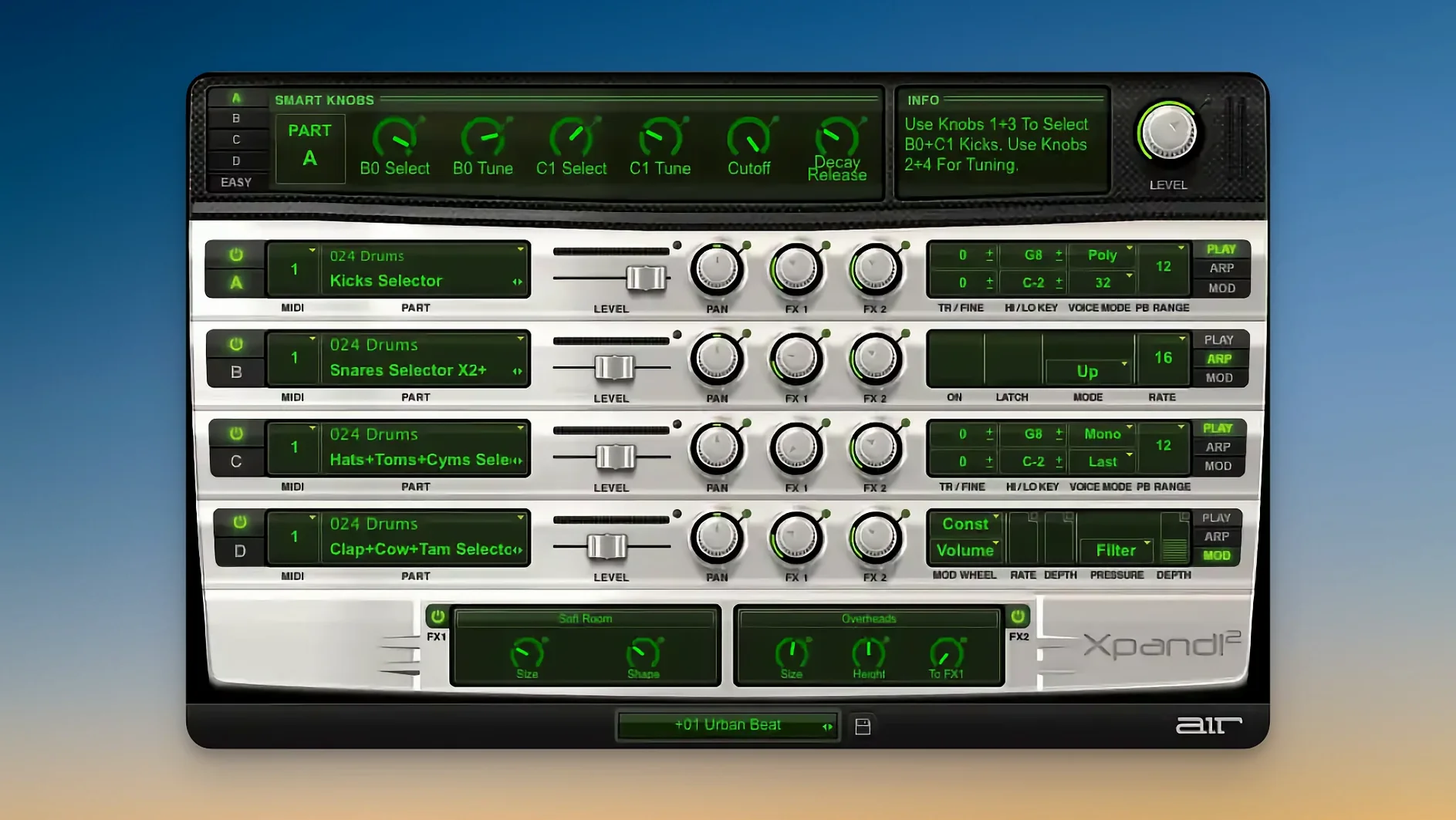
The arpeggiator on each of the four slots is where Xpand!2 starts to feel like a workstation rather than a simple ROMpler. You can set a different pattern and rate per part, then layer them across the keyboard. Because each slot has its own MIDI channel, note range, mix, and effects, you can build a patch that behaves like a small ensemble, not just a stacked sound.
Four slots, one patch
Every preset combines up to four active sound slots. Polyphonic parts go up to 64 voices, which is enough for sustained pads and busy arpeggios without choking. The interface scales cleanly and supports HiDPI and Retina displays, so the controls stay legible on a modern Mac. Each slot also carries its own modulation routing and effects, which means you can treat the slots as independent instruments inside a single instance.
Performance and integration
Xpand!2 responds to Pitch Bend, Aftertouch, and MIDI Learn, so it maps well to a hardware controller. Originally part of the Creative Collection for Avid Pro Tools, it has grown into a standalone multitimbral tool. The plugin runs natively on Apple Silicon and requires macOS 13 or later. For a Mac-based studio, it is a practical way to get layered, sequenced parts running quickly without loading several instances.
Runs natively on Apple Silicon without Rosetta
Given the version 2.3.1 requirements — macOS 13 or later and Apple Silicon — Xpand!2 runs as a native ARM binary. There is no Rosetta translation layer involved, which is one less variable when you are tracking down a CPU spike or a plugin scan failure. The installer is a standard package, and activation is handled by the included tools from the developer. The plugin format itself is Audio Units and AAX; VST3 is not listed in the facts, so you will want to check your host’s supported formats before committing to a workflow around it.
The interface is English only, so no localisation quirks to navigate. Scalable and HiDPI-ready means it will render cleanly on a Studio Display or a MacBook Pro’s XDR panel without forcing you to squint or to zoom the entire DAW. Expect the plugin browser to load the full 2,500+ preset list on first scan; the category tree is flat enough that you can drill down by instrument type rather than scrolling through one long alphabetical list.
Work through the 29 preset categories to learn the four-slot architecture
Spend the first session working through the 29 preset categories systematically. Open a blank project, load Xpand!2 on a MIDI track, and click through the categories one by one. The four-slot architecture is not immediately obvious from the preset name alone — some patches use all four slots, others use one or two. Listening this way gives you a mental map of what is actually inside the library, rather than relying on the browser search later when you are under time pressure.
Map MIDI Learn to the six smart controls early. Assign them to knobs or faders on your controller, then save that as a default template within the plugin. The smart controls are the fastest way to adjust the core sound across all four slots without diving into individual slot parameters. If you skip this step, you will end up clicking on-screen knobs during a take, which is slower and less musical.
Set up one patch with all four slots on separate MIDI channels. This is the multitimbral use case that the plugin was designed for. Assign channel 1 to a bass, channel 2 to a pad, channel 3 to an arpeggio, and channel 4 to a lead. Record a short chord progression on each channel and listen to how the slots interact. This test alone will tell you whether the plugin fits your typical arrangement style or whether you will use it mostly as a single-sound source.
Check your DAW’s track count and plugin instance limits early. Because each Xpand!2 instance can hold up to four sounds, you may need fewer instances than you expect. That can free up system resources, but it also means more routing — each slot’s MIDI channel and note range must be set correctly to avoid notes triggering the wrong part.
Version 2.3.1 brought a native Apple Silicon binary for older Avid plugin
Version 2.3.1 is the current build. For a plugin of this age — originally developed for the Avid Creative Collection — the shift to a native Apple Silicon binary is the most significant change in recent years. Earlier Intel versions ran under Rosetta 2 on Apple Silicon Macs, which worked but added an extra layer of translation and occasional graphics lag on Retina displays. The native version eliminates that entirely.
The interface scaling and HiDPI support were not present in the earliest Creative Collection releases. Users who upgraded from those older versions will notice that the plugin no longer looks tiny or blurry on high-resolution screens. The smart controls and the four-slot layout are unchanged, which is fine — the workflow was already functional. What changed is how the plugin behaves on a modern Mac: faster scanning, no graphics artefacts, and consistent responsiveness when switching presets or adjusting parameters.
The 2,500+ preset library has not been expanded in recent updates, but the categories and organisation remain the same. If you already owned a previous version, you are not getting new sounds — you are getting a stable, native version that works reliably on current hardware.
Set MIDI channels 1-4 to control each of the four sound slots separately
I start a session by loading one instance of Xpand!2 on a new instrument track. The first thing I do is set the MIDI channel for slot A to 1, slot B to 2, slot C to 3, and slot D to 4. This is a habit from the days of hardware multitimbral modules, and it saves time later when I want to route different MIDI clips to different parts.
I browse the preset categories for a foundation sound. The Bass and Pad categories are my usual starting points. I load a layered pad into slot A and a sub-bass into slot B. Slot A is set to polyphonic, 64 voices, because pads need sustain and voice stealing ruins the tail. Slot B is monophonic, priority set to Last, so that the bass note always follows the last key I press — useful for legato lines.
Next I add an arpeggio part to slot C. I select a pluck or synth sound from the Arpeggiated category, then dial in a 16th-note pattern with the slot’s own arpeggiator. The arpeggiator rate is set to match the project tempo via MIDI clock sync. I restrict the note range for slot C to the middle two octaves so that the arpeggio does not clash with the bass or the pad. Slot D gets a lead sound, monophonic, highest priority, with a bit of pitch bend mapped to the smart controls for expressive playing.
With all four slots active, I record a MIDI clip for each channel. The bass plays a simple root-note pattern, the pad holds sustained chords, the arpeggio runs a repeating figure, and the lead plays a melody. Because each slot has its own effects chain, I add a reverb to the pad slot and a delay to the lead slot. The two global effect processors are used for a subtle compression across the whole mix.
During playback, I use the six smart controls to adjust the overall brightness and the level balance between slots. The arpeggiator on slot C is running in the background, and I can tweak its pattern length or rate without stopping the sequencer. When I need to change the lead sound, I swap the preset for slot D only — the other three slots keep playing their assigned parts. This is the practical advantage of the four-slot design: you can audition and replace one sound without losing the context of the other three.
By the end of the session, I have a layered arrangement that would have required four separate plugin instances in a simpler instrument. The whole patch is saved as a single preset, so I can recall it tomorrow with all the slot assignments, effects, and arpeggiator settings intact.
Before it goes on the Mac
- macOS 13 or later
- Apple Silicon
Questions from the room
How many simultaneous sounds can Xpand!2 play?
Each patch has four active sound slots, and polyphonic parts support up to 64 voices per slot.
Installing it on the Mac
- Install the plugin package.
- Follow the activation instructions included with the package.
Notes from the control room
Sign in or open a catalogue account to leave a note.
No notes from the room yet. If you have used this build for a week, a short note helps the next person.
Also filed under Logic Pro Plugins
The whole Logic Pro Plugins rack XLN Audio XO1.8.10 Logic Pro Plugins 2.3 GB
 Wave Alchemy Tapewave1.0.1 Logic Pro Plugins 356 MB
 VocalNet1.0.4 Logic Pro Plugins 669 MB
 UnderTone Audio UnFairchild1.0.8 Logic Pro Plugins 220 MB
 UJAM Symphonic Elements STRIIIINGS1.3.1 Logic Pro Plugins 4.4 GB
 uJAM Cinedream1.0.1 Logic Pro Plugins 3.5 GB
 Tsuga Audio MoonBass1.0.0 Logic Pro Plugins 7 MB
 Toontrack EZmix Bundle3.2.2 Logic Pro Plugins 977 MB