
Home › Logic Pro Plugins › FabFilter Total Bundle

FabFilter Total Bundle 29.10.2026 (Mac)
Updated
The catalogue note
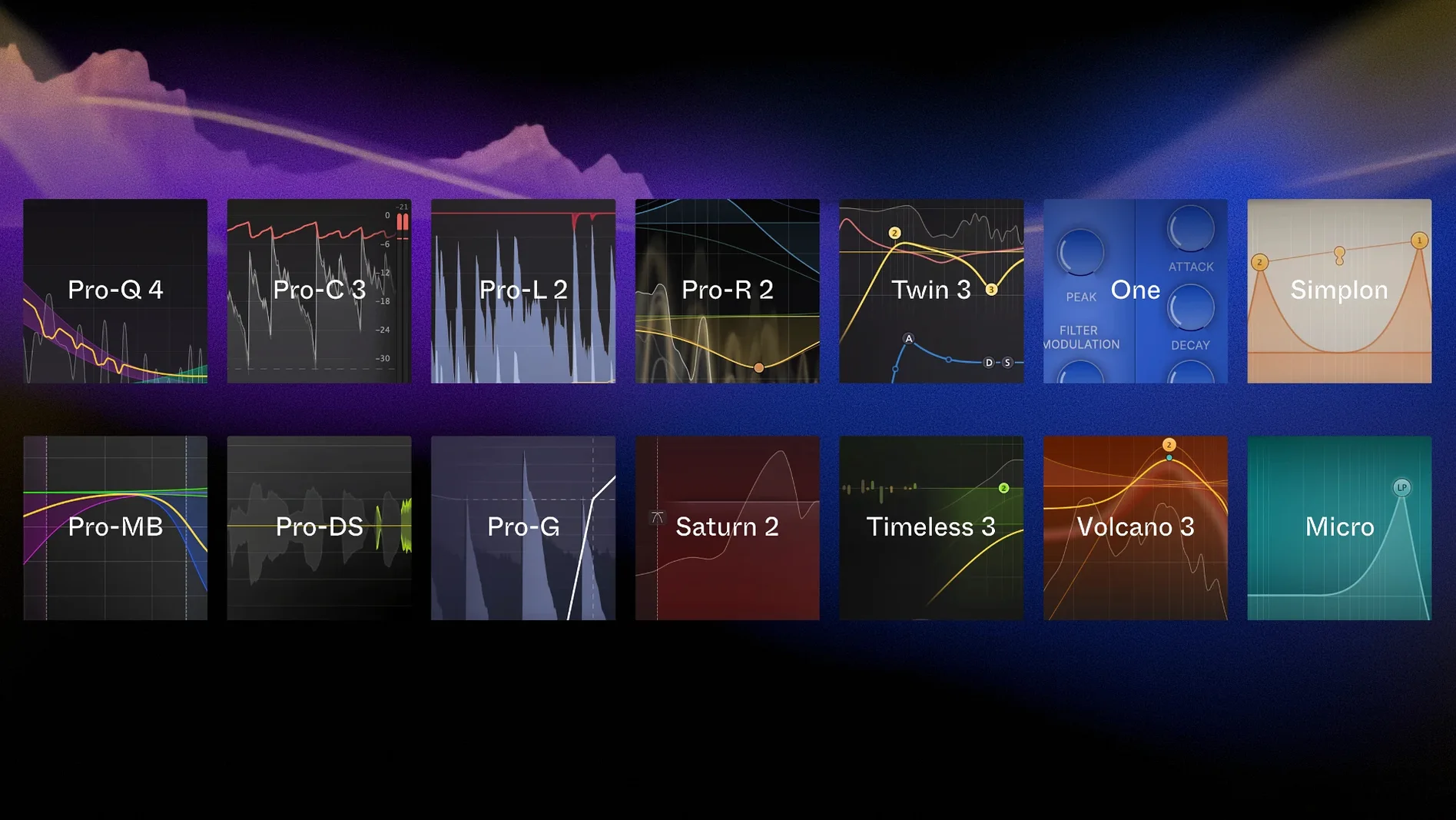
You already know the EQ and the limiter — the ones that appear in every mix session. The Total Bundle is the rest of the FabFilter catalogue alongside them: the creative tools an experienced user reaches for when the usual suspects aren't enough.
Shaping a sound that isn't there yet
Volcano 2, the multimode filter, and Twin 2, the polyphonic synth, turn a simple tone into something you can build a track around. The bundle also includes Saturn 2 for multiband distortion and Timeless 3 for tempo-synced delays — both deep enough to reward time spent learning their modulation routings.
Routing and side-chain work
Every plug-in in the bundle supports stereo and mid-side processing, and the Pro versions (Pro-Q 3, Pro-C 2, Pro-MB, Pro-L 2) give you internal side-chain filtering and dynamic EQ curves. That matters when you need a compressor that only triggers above 4 kHz or a limiter that ignores the low end.
Keeping CPU headroom
All FabFilter plug-ins are built with low-latency DSP and a unison mode for Pro Tools. On an Apple Silicon Mac you can run dozens of instances before the system meter moves. The bundle includes both AAX, VST3 and AU formats, so it works across Logic Pro, Pro Tools, Ableton Live and most other hosts.
What your Mac actually needs
The bundle runs on macOS 10.13 or later, covering High Sierra through the current releases. Both Apple Silicon and Intel 64-bit Macs are supported natively — no Rosetta translation needed for either architecture. The installer is a standard disk image: you open it and run the installer package, which places the components into the system-wide audio plug-in folders. No background services, no licence manager, no online activation step.
Each plug-in ships as a separate component, so your host only loads what the session actually uses. The bundle includes AAX, VST3 and Audio Unit formats, which covers Pro Tools, Logic Pro, Ableton Live, Cubase, Studio One, Reaper and most other DAWs on the Mac side.
Crank the interface zoom to 125% on a laptop screen
Most FabFilter plug-ins open with a default interface size that works on a 27-inch display but feels cramped on a laptop screen. In every Pro-series plug-in, the interface zoom control sits in the top toolbar — setting it to 125 or 150 percent from the start saves squinting during long sessions. The zoom persists per plug-in once you save a preset.
Inside Pro-Q 3, the spectrum analyser is enabled by default but set to a slow response. Bumping the analyser speed to "Fast" in the EQ display's context menu makes frequency spotting more immediate. The same menu lets you pin the analyser to pre- or post-EQ, which is useful when you want to see what the filter is doing rather than what the source already contains.
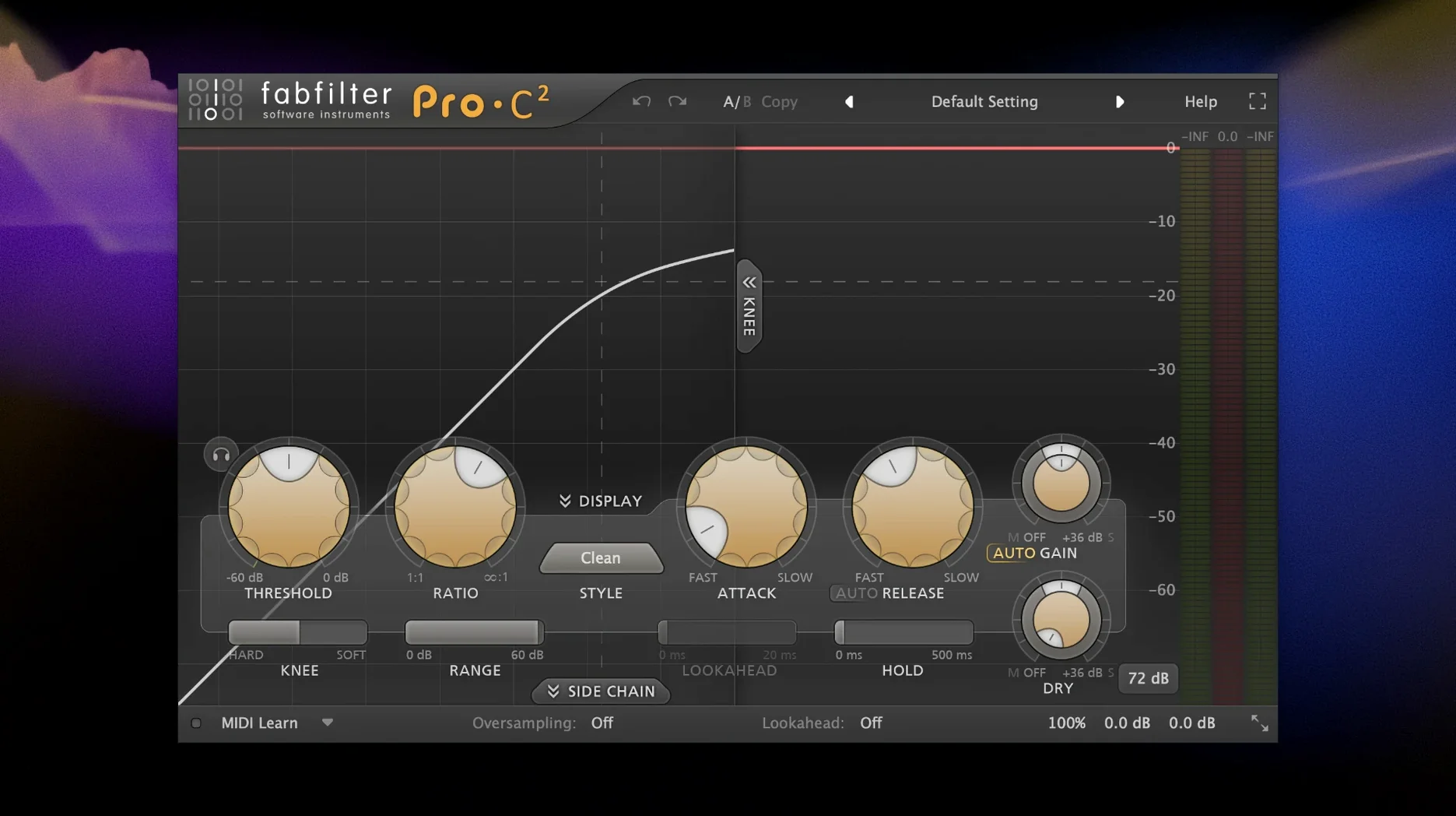
For Pro-C 2, the default metering shows gain reduction in a vertical bar. Switching the meter to "VU" or "RMS" in the meter section's dropdown gives a better sense of average level change, especially during mastering-style compression where the gain reduction is subtle.
Double-click the title bar for full-screen filter sweeps
- Every FabFilter plug-in has a full-screen mode (double-click the title bar) that hides the host's own interface clutter. Useful when you are fine-tuning a filter sweep on Saturn 2 and need the modulation matrix visible without scrolling.
- The undo/redo system in Pro-Q 3, Pro-C 2 and Pro-MB stores the last 50 steps. Ctrl+Z and Ctrl+Shift+Z work across EQ band moves, compressor threshold changes and multiband crossover adjustments — no need to reach for the mouse.
- All plug-ins remember the last-used preset folder between sessions. If you store your own starter templates in
~/Documents/FabFilter, the browser opens there by default after the first save. - The AAX versions include the same interface and feature set as VST3 and AU. No stripped-down Pro Tools variants — what you learn in Logic transfers directly.
A real-world session: mixing a sparse arrangement
A mixing engineer working on an acoustic trio — vocal, nylon-string guitar, double bass — might reach for four plug-ins from the bundle and leave the rest unloaded. Pro-Q 3 handles the vocal's low-mid mud around 250 Hz with a dynamic bell that only cuts when the singer leans into the mic. Pro-C 2 on the bass uses its "Opto" style with a 2:1 ratio and a slow attack, catching only the transient peaks of the fingerstyle attack. Pro-R on the vocal sends a small room reverb that doesn't wash over the guitar's body resonance — the reverb's decay rate EQ, accessible from the main panel, rolls off the low end below 300 Hz. Finally, Pro-L 2 on the master bus applies 2–3 dB of gain reduction with the "Clean" clipping style engaged, just enough to lift the average level without hardening the guitar's transient. No side-chain routing, no automation — just four instances, each doing one thing precisely.
Incremental filter shapes and spectrum upgrades in Pro-Q 4
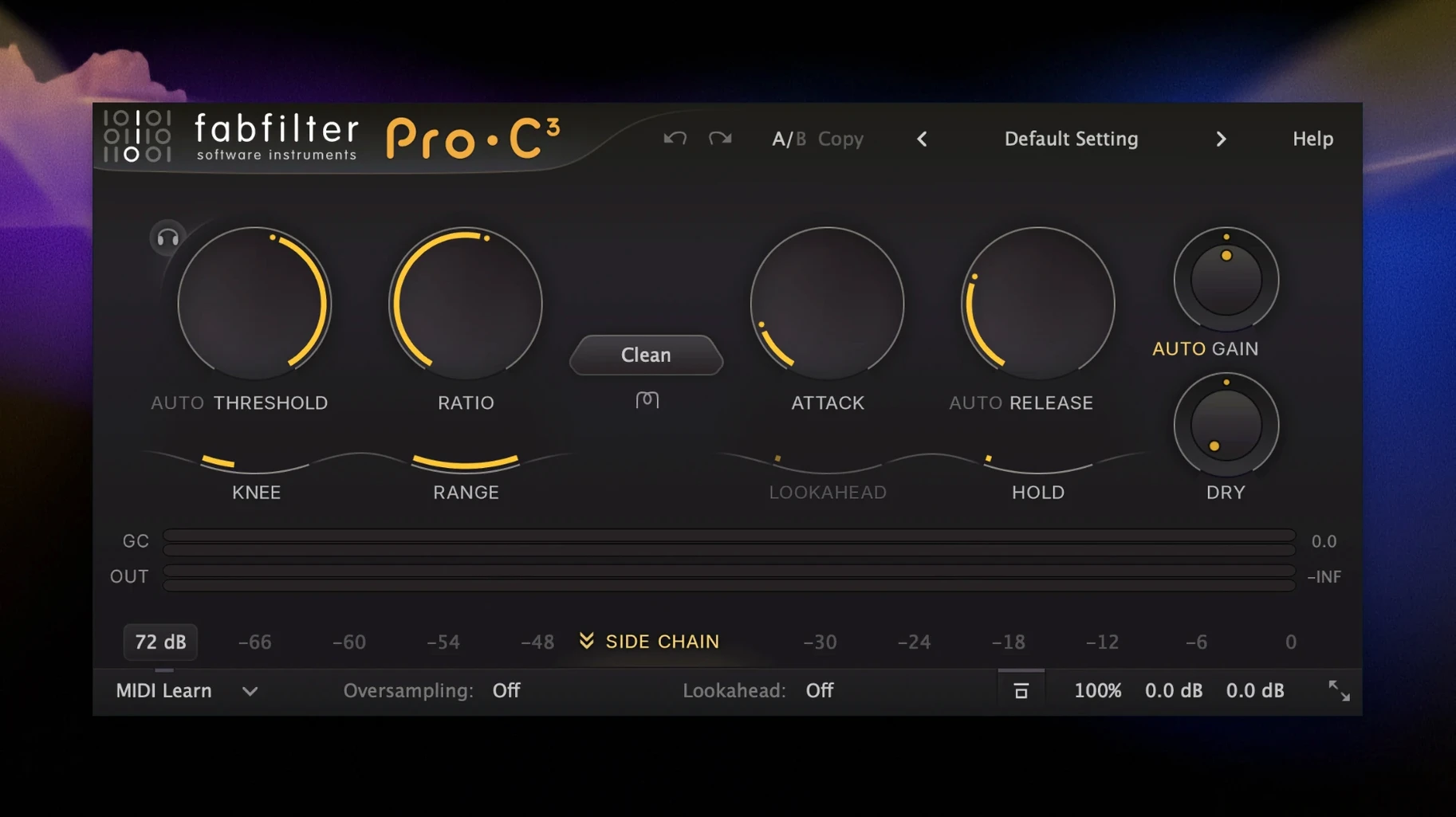
The bundle listing now includes Pro-Q 4.13, Pro-R 2.06 and Pro-C 3.02. For the engineer who already knows the previous versions, the changes are incremental rather than foundational. Pro-Q 4 adds a few new filter shapes and an improved spectrum analyser with better transient response — the kind of update that makes surgical cuts faster but doesn't change the workflow you already built. Pro-R 2 refines the reverb's character controls slightly, giving a bit more range in the "Brightness" and "Distance" parameters. Pro-C 3 tweaks the internal side-chain filter's slope options, which matters if you rely on frequency-conscious compression rather than broadband levelling. None of these updates break existing sessions or require re-saving presets, which is the practical test for a bundle that lives in your template tracks.
Side-chain routing without leaving the plug-in
Inside Pro-C 3, Pro-MB and Pro-Q 4, the internal side-chain section lets you filter the detector signal before it triggers compression or EQ movement. In Pro-C 3, clicking the side-chain button in the panel header opens a mini EQ curve where you can roll off low frequencies or boost a specific band. That means a compressor on a bass guitar can be set to react only to the 80 Hz fundamental while ignoring the string noise above 2 kHz. The same filter appears in Pro-MB, where each band can have its own side-chain EQ — useful when you want the high band to compress based on the low band's content, or vice versa.
Setting up your own default start screen
Every Pro-series plug-in opens with a factory default that may not match your typical first move. In Pro-Q 4, you can create a blank EQ with a single flat band at 0 dB, save it as a preset called "Start Here", then right-click the preset browser and set it as the default for new instances. After that, every new instance loads your starting point rather than the factory one.
For Saturn 2, the default preset loads a single-band distortion with a neutral curve. If you regularly use the multiband mode with three bands, save that as your default — the plug-in remembers band counts and crossover frequencies across instances once you set the default.
Quick access to the modulation matrix
In Saturn 2, Timeless 3 and Volcano 2, the modulation matrix is the core of the creative sound design. Clicking the "Mod" button in the top toolbar opens the full list of modulation slots, where you can assign an envelope follower, LFO, XY controller or MIDI note to any parameter. The matrix shows each slot as a row with source, destination, amount and polarity. Holding the Shift key while dragging a modulation amount slider snaps to 0 percent, 50 percent or 100 percent — useful when you want to set a precise 50 percent depth without typing a number.
Timeless 3 also includes a feedback routing section in the mod matrix. You can route the delay output back through the filter or the distortion stage before it repeats, which changes the tone of each echo independently. The routing is per-tap, so left and right delays can have different feedback paths.
Preset management across the bundle
All plug-ins share the same preset browser. Pressing the left/right arrow keys on the keyboard cycles through presets in the current folder — no need to click the dropdown each time. The browser also shows a waveform preview for the selected preset (in Pro-Q 4, Pro-C 3, Pro-MB, Pro-L 2 and Saturn 2), so you can see the EQ curve or compression envelope before loading it.
If you organise presets into subfolders by instrument or task (e.g., "Vocal EQ", "Room Reverb", "Master Limiter"), the browser remembers the last-opened folder per plug-in type. That means Pro-R 2 always opens to your reverb presets, while Pro-Q 4 opens to your EQ presets, even if they sit in different folders.
What the bundle covers in one session
- Pro-Q 4: dynamic EQ, linear phase, spectrum analyser with transient mode
- Pro-R 2: algorithmic reverb with decay rate EQ and space character controls
- Pro-C 3: compressor with four styles (Clean, Classic, Opto, Vocal) and internal side-chain filter
- Pro-MB: multiband compressor and dynamic EQ in one plug-in, up to six bands
- Pro-L 2: limiter with four clipping styles and true peak metering
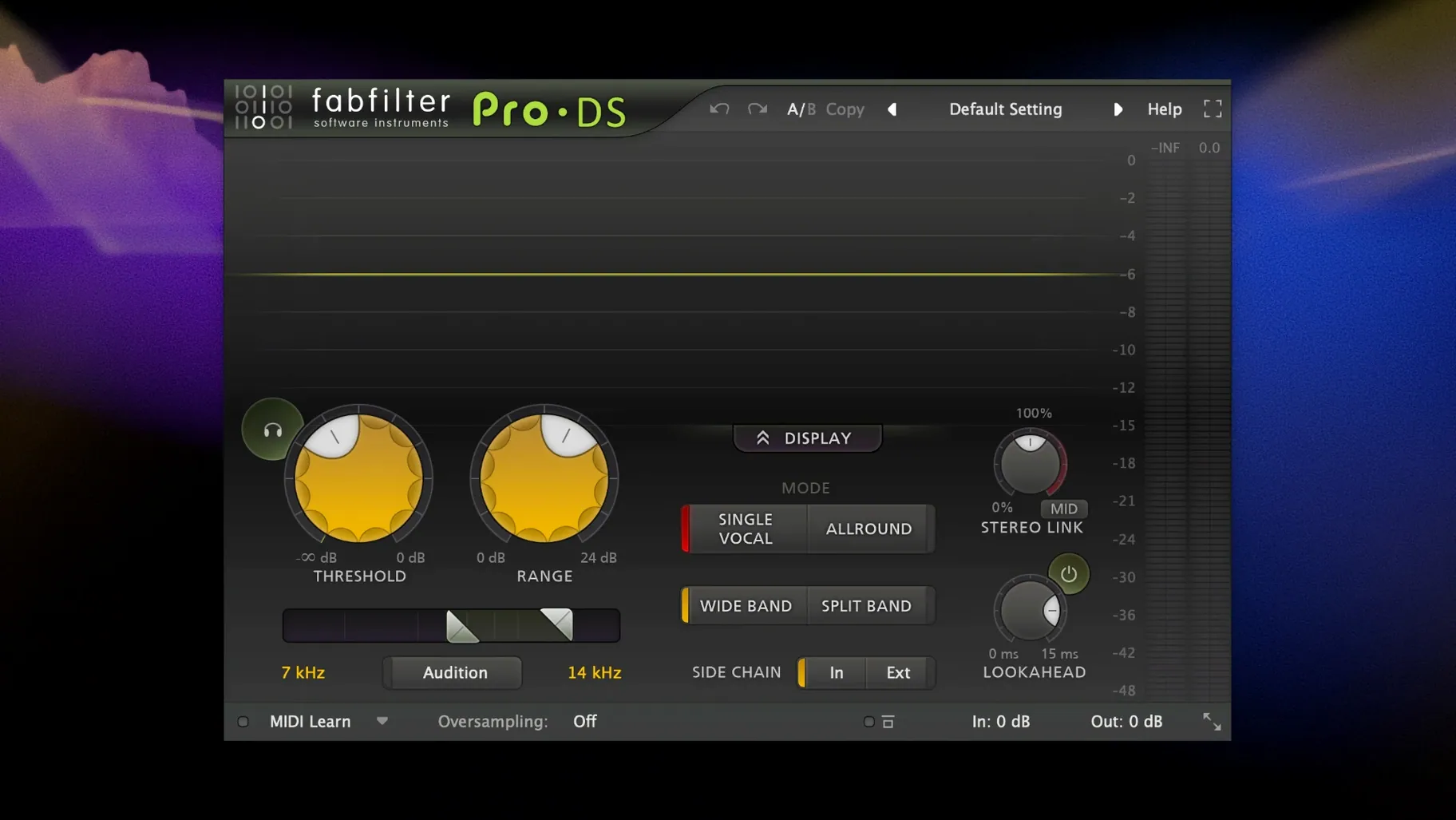
- Pro-DS: de-esser with single-band and multiband detection modes
- Pro-G: gate and expander with side-chain filtering and lookahead
- Saturn 2: multiband distortion with 28 distortion styles and modulation
- Timeless 3: stereo delay with tape echo, pitch shifting and feedback routing
- Volcano 2: multimode filter with 12 filter types and modulation
- Twin 2: polyphonic subtractive synthesizer with dual oscillators and filter section
- Simplon: simplified filter plug-in with four filter modes and drive
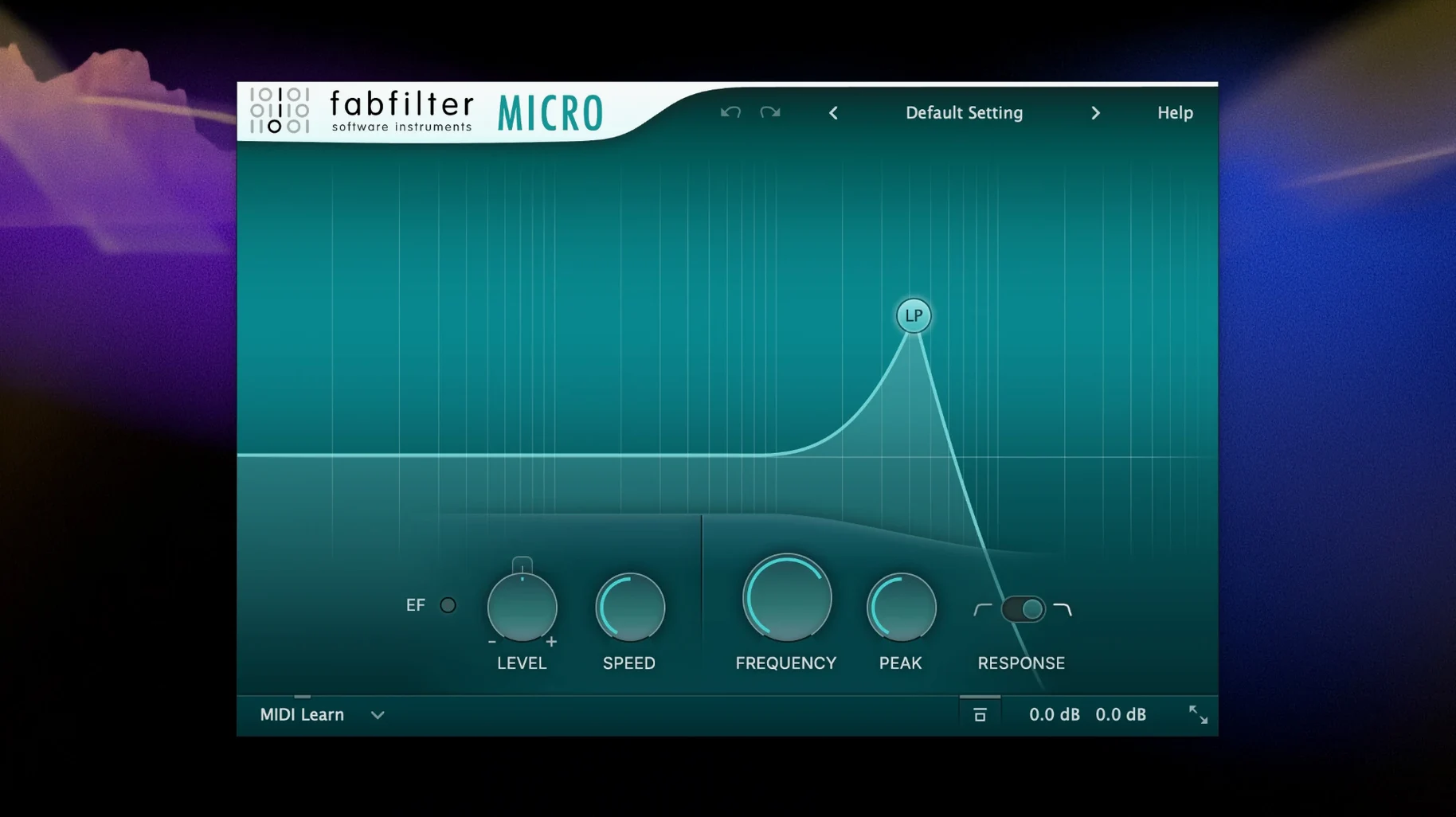
- Micro: minimalist EQ with three bands and no analyser
- One: minimalist compressor with threshold, ratio and make-up gain
That is the full set. No plug-in is a demo or a cut-down version — each one matches the standalone release.
Changes in this build
The 29 October 2026 bundle refresh ships an updated installer. The main event is FabFilter Twin 3.10, which gains MPE and Note Expression support—polyphonic per-note control, plain and simple. Over 200 factory presets land for Twin 3 alongside it. The rest of the plug-ins carry no confirmed individual changes in this build.
Before it goes on the Mac
- macOS 10.13 or later
- Apple Silicon or Intel 64-bit
Questions from the room
Which host formats are included?
The bundle includes AAX, VST3 and AU plug-in formats for compatibility with Pro Tools, Logic Pro, Ableton Live and other major DAWs.
Does it work on Apple Silicon Macs?
Yes, the bundle is listed for both Apple Silicon and Intel 64-bit Macs, and runs natively on M1, M2 and M3 systems.
What is the minimum macOS version required?
macOS 10.13 High Sierra is the minimum requirement for the Total Bundle.
Installing it on the Mac
- Mount the downloaded disk image.
- Run the installer and follow the on-screen steps.
Notes from the control room
Sign in or open a catalogue account to leave a note.
No notes from the room yet. If you have used this build for a week, a short note helps the next person.
Also filed under Logic Pro Plugins
The whole Logic Pro Plugins rack EZbass1.3.3 Logic Pro Plugins 81 MB
 Expressive E Soliste1.0.3 Logic Pro Plugins 951 MB
 Excite Audio Lifeline Expanse1.3.0 Logic Pro Plugins 352 MB
 elastiquePitch2.5.0 Logic Pro Plugins 17 MB
 Help Me Devvon HMD Uncompressor1.0.03 Logic Pro Plugins 38 MB
 Cymatics VOXITY1.0.0 Logic Pro Plugins 97 MB
 Cymatics QUAKE1.0.0 Logic Pro Plugins 1.6 GB
 iZotope Neutron5.2.0 Logic Pro Plugins 928 MB