
Home › VST Plugins › Effectrix
Effectrix 1.4.8 (Mac)
Updated
The catalogue note
Effectrix runs on any Mac from macOS 10.14 (Mojave) upwards, Intel and Apple Silicon alike. The installer gives you a 64-bit plugin that works in Audio Unit, VST2, VST3, AAX, and as a standalone application. No Rosetta worries, no legacy format hunting — it just loads.
Formats and host compatibility
- Audio Unit, VST2, VST3, AAX, standalone
- 64-bit only; macOS 10.14 or higher
- Intel and Apple Silicon native
- Single installer, all formats included
What it does, briefly
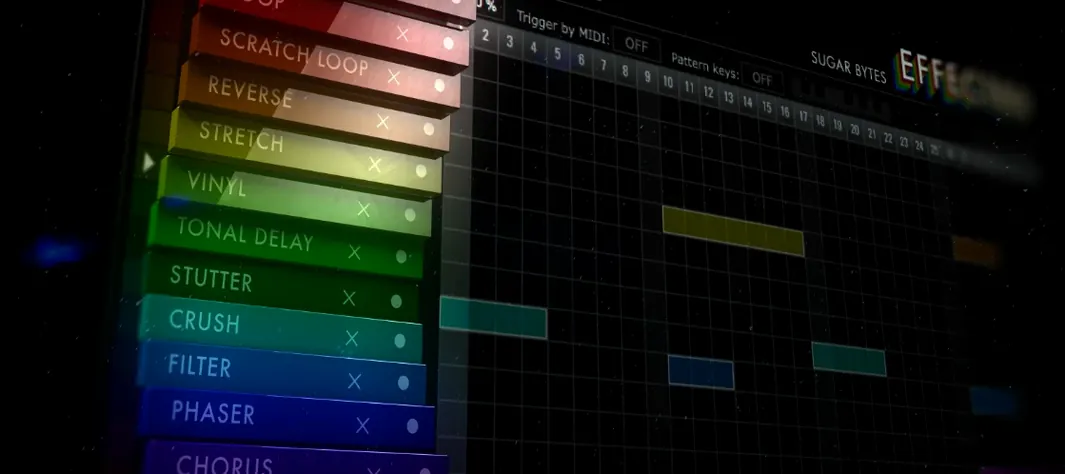
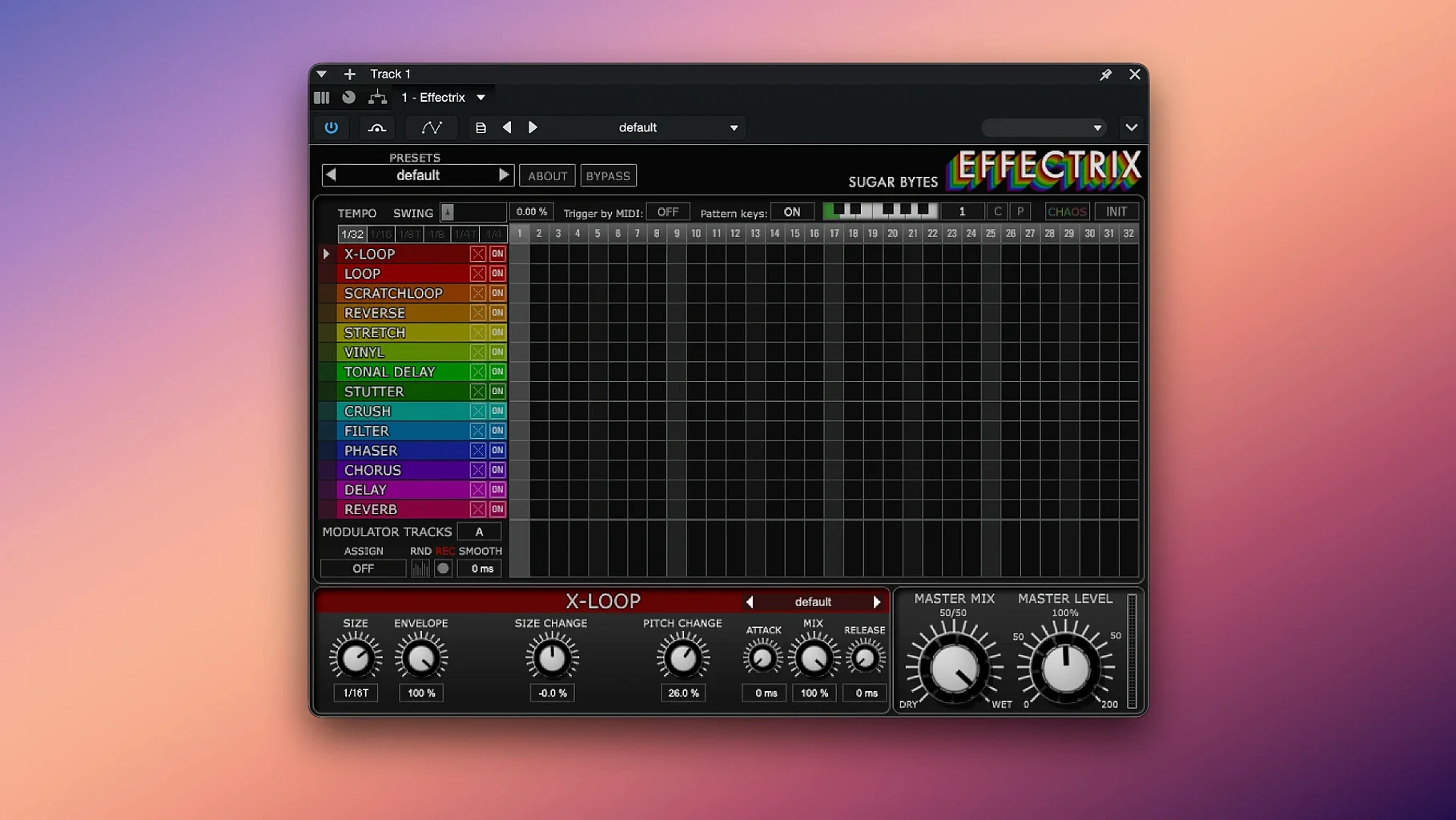
Effectrix arranges fourteen synchronised effects on a step grid. Each effect has its own set of parameters, and you can stack two modulation tracks per step. The swing function loosens the quantised feel. A preset holds up to twelve different sequences; the global preset bank covers hundreds of ready-to-run configurations. Copy and paste between steps speeds up building complex chains. The sound is clean, the routing is flexible, and the interface stays out of the way once you learn the grid logic.
Respects standard plugin formats in Logic Pro and other DAWs
Effectrix sits well in most DAW environments because it respects the standard plugin formats and doesn't demand unusual routing. In Logic Pro, it loads as an Audio Unit insert on any track or bus, and the step sequencer responds to host transport and tempo changes without extra configuration. Ableton Live users can run it in VST3 or AU form; the standalone version works as an external effect processor via IAC or virtual audio routing if you prefer to keep the sequencer outside the DAW. On the desktop, the standalone window accepts MIDI input from any source the Mac sees — a controller keyboard, a pad grid, or an internal MIDI pipe — which makes it usable as a live effects processor without launching a host at all.
macOS features like Audio MIDI Setup and the built-in IAC driver let you route MIDI clock and notes between Effectrix and other software. If you run the standalone version and route audio through BlackHole or Soundflower, you can process any Mac audio — streaming, video, system sounds — through the step grid. The plugin version sidesteps that complexity and simply syncs to the DAW clock.
Start with a drum loop or synth pad and click through global presets
Start with a simple drum loop or a sustained synth pad on a track in your DAU. Insert Effectrix as an insert effect. Open the plugin window and click through the global presets to find one that approximates the feel you want — something with a stutter or a filter sweep. Once you have a base sound, clear the step grid by selecting all steps and deleting the active effects.
Set the cycle length to 16 steps and the tempo division to 1/8. On step 5, assign the Filter effect with a bandpass shape and a slow sweep. On step 9, assign the Shuffler effect with a small fragment size and no pitch shift. On step 13, assign the BeatRepeat effect set to a half-bar loop. Now activate the first modulation track on step 3 and draw a slow volume fade; activate the second modulation track on step 11 and draw a filter cutoff rise.
Copy the first four steps and paste them onto steps 5 through 8 to create a variation. Adjust the filter frequency on the pasted steps so the second half of the bar sounds different. Save the sequence as a preset, then recall it from a MIDI keyboard using the 12 pattern slots — map the note range to your controller and switch patterns live while the loop plays. The Chaos button randomises the active effects and their parameters, which can break a stuck pattern into something useful in seconds.
Apple Silicon native support and VST3 format added in version 1.4.8
- Apple Silicon native support means no Rosetta translation layer, which matters when running multiple instances in a session
- VST3 format added alongside the existing VST2 and AU options, improving compatibility with newer DAW versions that phase out VST2
- AAX support for Pro Tools users, which was not present in earlier versions
- Standalone operation became possible, allowing use outside a DAW entirely
- General stability improvements under modern macOS releases, particularly Big Sur and later
In practice, the most noticeable change is the removal of the Intel-only restriction. Earlier versions required Rosetta 2 on Apple Silicon Macs, which added overhead and occasional GUI lag. Version 1.4.8 runs natively, so the interface responds immediately and the plugin loads faster in a host. The addition of VST3 also means you can use Effectrix in DAWs that have dropped VST2 support — Studio One and Cubase 12 onwards, for example.
Adjust cycle length and press the Chaos button early
When you first load Effectrix, the default grid might feel too rigid. Adjust the cycle length from the default 16 steps to 8 or 12 if you want shorter, more repetitive patterns. The Chaos button is worth pressing early on: it randomises the entire grid and gives you a starting point that you can then edit step by step.
Set up the 12 pattern recall slots by assigning MIDI notes in the plugin's settings. A single octave on a keyboard controller gives you access to all twelve sequences. This is faster than clicking through presets with a mouse during a live take or a recording session. Save a few global presets with different swing amounts, cycle lengths, and effect combinations — you can load them from the browser in seconds.
Runs on macOS 10.14 or later with all four plugin formats in one package
Effectrix requires macOS 10.14 or later and works on both Intel and Apple Silicon Macs. The installer places all four plugin formats (AU, VST2, VST3, AAX) plus the standalone application in one package. There is no separate installer for each architecture. The plugin is 64-bit only, so it will not load in a 32-bit host — this is standard for modern audio software and affects no current DAW.
The standalone version launches as a regular macOS application and appears in the Applications folder. It accepts MIDI input from any connected device and outputs audio through the system's default output or a selected audio interface. A Mac that runs a modern DAW without trouble will run Effectrix without trouble.
For anyone searching for older distribution channels — effectrix rutracker, effectrix crack mac, effectrix torrent, effectrix mac, effectrix crack — the official version 1.4.8 is the current release and supports all Mac hardware from the last several years. There is no need to hunt for outdated builds or workarounds.
Before it goes on the Mac
- macOS 10.14 or later
- 64-bit Intel or Apple Silicon processor
- Interface language: English
Questions from the room
Does Effectrix run on Apple Silicon Macs?
Yes. The installer includes a native 64-bit binary that works on both Intel and Apple Silicon Macs.
Which plugin formats does Effectrix ship in?
Audio Unit, VST2, VST3, AAX, and standalone. All come in the same installer.
How many effects are built in?
Fourteen synchronised effects, each with its own parameter set. The global presets cover hundreds of combinations.
Installing it on the Mac
- Run the installer and follow the on-screen prompts.
- Open your host DAX and scan the plugin folders or locate the standalone application.
- Activation instructions are included in the package; read the supplied text or PDF file.
Notes from the control room
Sign in or open a catalogue account to leave a note.
No notes from the room yet. If you have used this build for a week, a short note helps the next person.
Also filed under VST Plugins
The whole VST Plugins rack EZdrummer3.1.2 VST Plugins 786 MB
 Devious Machines Infiltrator2.5.26 VST Plugins 46 MB
 iZotope Insight2.4.0 VST Plugins
 Komplete Kontrol3.5.4 VST Plugins 785 MB
 Baby Audio IHNY-21.5.0 VST Plugins 28 MB
 LFOTool1.768 VST Plugins 7 MB
 Arturia Rotary CLS-2221.2.0 VST Plugins 359 MB
 Arturia Modular V3.13.3 VST Plugins 707 MB